

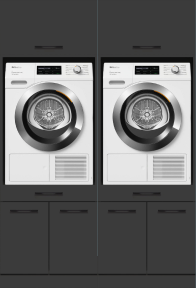
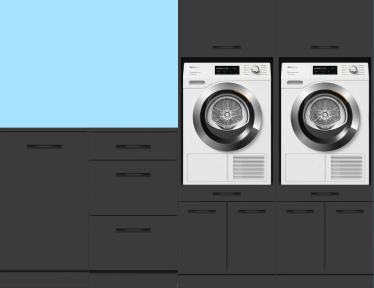
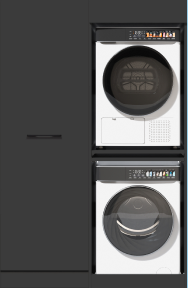
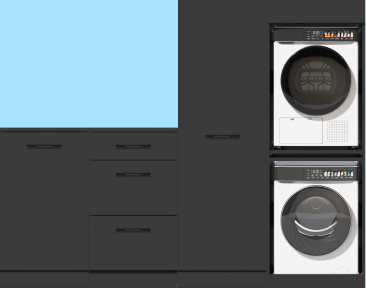
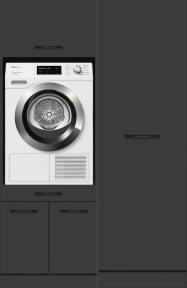
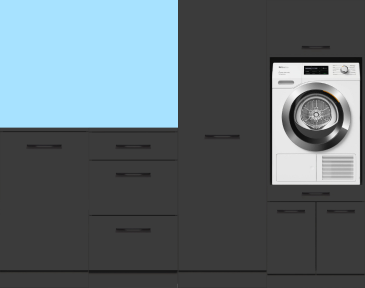
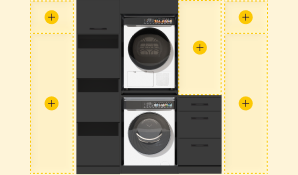
Determining the correct niche dimensions is crucial for a quiet, safe, and neat installation. For most front loaders, calculate 60 cm appliance width, about 85 cm height, and 60 to 70 cm depth. For a precise fit, we recommend an internal cabinet size of 64 cm wide, 88 cm high, and 70 cm deep, plus extra installation space behind the machine for hoses and plug. Wasdroom cabinets are made of strong chipboard with melamine coating and have a load capacity of up to 240 kg (Double) or 120 kg (Single and Stack) per cabinet, ensuring your setup is stable and meets TÜV requirements.
Standard built-in dimensions and rules of thumb
Appliance sizes vary by brand and model, but the range is predictable. Most front-load washing machines are 59.5 to 60 cm wide and 84 to 85 cm high. Depth varies the most: from about 56 cm for compact tubs to 67 cm for large drums, excluding door and hose bends. Therefore, plan clearance around:
- Width: internal niche 64 to 66 cm for 60 cm appliances.
- Height: at least 88 cm for single placement on floor position.
- Depth: 70 cm internal depth works best in practice.
- Rear space: 5 to 10 cm free zone for hose and cable radius.
- Ventilation: ensure openings, especially for dryers.
For a complete overview of guideline dimensions, see the Standard built-in dimensions for a washing machine cabinet.
Always check the datasheet of your specific machine and dryer. Use the largest measurement as a starting point and add clearance and ventilation.
Read more about the required clearance in free space around the washing machine.
This is how you measure your niche and space flawlessly
- Measure the width at 3 points: bottom, middle, and top. Note the smallest measurement as the starting point.
- Measure the depth from the back wall to the front of the plinth or frame. Include any existing pipes.
- Measure the height from the floor to the underside of the top or ceiling. Watch out for protruding beams or pipes.
- Check the passage: does the cabinet fit through doors, stairs, and corners? Also measure diagonally.
- Check the floor: is it level and load-bearing? Consider adjustable feet and vibration dampers.
- Note the positions of water, drain, and power outlet. Plan 5 to 10 cm slack for hoses.
- Check the swing directions of any cabinet doors and the washing machine door.
Want to be sure you measure correctly? Follow the step-by-step guide measuring yourself for the perfect fit.
Dimensions per setup
Only a washing machine
In a solo setup, everything revolves around width clearance and hose space behind. For depth, the combination of tub depth, door thickness, and bend of the drain hose is decisive. If you work with a front plinth or door, add extra margin so the door does not hit the drum door.
Washing machine and dryer side by side
Plan the same clearance per appliance as in a solo setup and add them together. A center post in the cabinet provides sturdiness and keeps appliances geometrically separated, reducing vibrations. For heat pump dryers, extra ventilation inlet and outlet are important, preferably low and high in the cabinet fronts or via grilles. Unsure about the required dimensions? See the depth of washing machine and dryer: which cabinet fits?.
Stacked: washing machine below, dryer above
When stacking, niche height and column stability are especially important. Use a stacking kit or pull-out shelf suitable for your brands. Plan extra free space above the dryer for warm airflow and possible condensate drainage. Read more about the free space above the washing machine. Anchor the cabinet to the wall and check the wall quality.
Safety, ventilation, and load capacity
Stability starts with load capacity and anchoring. Wasdroom cabinets support up to 240 kg (Double) or 120 kg (Single and Stack) per cabinet and are anchored with wall brackets for extra security. A flat, level floor prevents wandering and resonance. Vibration-absorbing sheet material with melamine coating reduces contact noise and is splash-proof.
Ventilation is crucial, especially with a dryer in the cabinet. Guideline: ensure sufficient airflow area in the plinth, sides, or top panel. Install ventilation grilles or keep open zones free so heat can escape and be drawn in. Leave 5 to 10 cm of space behind for hoses and cables, and avoid kinks that obstruct flow.
Always anchor the cabinet to a load-bearing or sturdy wall and adjust the legs precisely. Test at maximum spin speed and listen for resonances. Arrange cables and hoses neatly to prevent slipping.
Common measurement mistakes that ruin the fit
- Measuring only at one point and not accounting for uneven walls.
- Estimating depth without including door thickness and hose bends.
- Not planning extra rear space for plug and siphon.
- Forgetting to mark ventilation openings, especially with heat pump dryers.
- Not accounting for baseboards, frames, and door handles in the passage.
- Not anchoring or not leveling adjustable feet.
- Ignoring datasheet and assuming “standard” while the model differs.
Quick overview: minimum internal niche dimensions per situation
| Situation | Min. internal width | Min. internal depth | Min. internal height | Extra rear space |
|---|---|---|---|---|
| Single washing machine (front loader) | 64 cm | 70 cm | 88 cm | 5 to 10 cm |
| Single dryer (heat pump) | 64 cm | 70 cm | 88 cm | 5 to 10 cm |
| Washing machine + dryer side by side | 2 x 64 cm + 2 to 4 cm center post | 70 cm | 88 cm | 5 to 10 cm |
| Stacked washing machine + dryer | 64 cm | 70 cm | 180 to 190 cm | 5 to 10 cm |
| Washing machine top loader | 48 to 50 cm | 60 to 65 cm | 95 cm (lid clearance) | 5 cm |
FAQ: dimensions and fit of washing machine cabinet
How big should a cabinet be for a washing machine?
For most front loaders, an internal niche of about 64 cm wide, 88 cm high, and 70 cm deep works reliably. Also plan 5 to 10 cm rear space for hoses and plug, and ensure ventilation openings.
What is the standard size of a built-in washing machine?
Many machines are about 60 cm wide and 84 to 85 cm high. Depth varies from about 56 to 67 cm. Take the largest value from your model’s datasheet and add clearance and rear space.
What is the standard width of a washing machine cabinet?
For a single appliance, 64 to 66 cm internal width is common. For two appliances side by side, calculate 2 x 64 to 66 cm plus 2 to 4 cm center post for stability.
How deep should a cabinet for a washing machine be?
With 70 cm internal depth, you’re well covered for most models in practice. This accounts for tub depth, door thickness, and bends in drainage and supply. Want to know the nuances and exceptions? Read how deep should a washing machine cabinet be?.
Does a top loader fit in a washing machine cabinet?
Yes, but the dimensions differ. Top loaders are often 40 to 45 cm wide and about 90 cm high. Plan for 48 to 50 cm internal width and at least 95 cm height so the lid opens freely.
Ready to smartly organize your laundry space? Wasdroom offers single, double, and stacked solutions with high load capacity and a 10-year warranty. Check the product specifications per model and choose the cabinet that fits your niche dimensions and appliances exactly.
Leave a comment
This site is protected by hCaptcha and the hCaptcha Privacy Policy and Terms of Service apply.