

A quiet laundry room doesn’t start with a single solution but with the right combination of setup, substrate, and damping. Do you hear banging, thumping, or vibrations from your washing machine through the floor, wall, or cabinet? Then you are usually dealing with a mix of impact noise and airborne noise. By smartly addressing these two separately, you can noticeably reduce noise nuisance in the laundry room.
Whether you have a washing machine on a wooden floor, use a washing machine cabinet, or want to make an entire laundry room quieter: with the right sound insulation and vibration damping, you prevent resonance, limit transmission to other rooms, and create a more stable setup. Below you’ll read where the noise comes from, which solutions really help, and which mistakes you want to avoid.
Where does noise in the laundry room come from?
Noise nuisance in a laundry room rarely arises solely from the washing machine’s motor. In practice, it is mainly vibrations that spread through the floor, cabinet, or wall. Especially during spinning, small imbalances can already cause a thumping effect throughout the rest of the house.
When insulating sound in the laundry room, it is important to distinguish between two types of noise:
- Impact noise - vibrations transmitted through the floor, cabinet, or structure.
- Airborne noise - sound that radiates directly from the machine into the room.
If you only look at a sound-dampening mat under the washing machine, you often only address part of the problem. Especially in a compact laundry room or when placing the machine in a cabinet, the substrate, free space, and material choice all work together.
Impact noise and airborne noise require a different approach
Impact noise is usually the biggest cause of disturbance. The washing machine vibrates, the floor picks up that movement, and the sound spreads to adjacent rooms. On a concrete floor, this effect often remains limited, but on a wooden floor, it is quickly amplified. Wood is lighter, more flexible, and more sensitive to resonance, causing the sound to be louder and hollow.
Airborne noise behaves differently. You mainly hear the drum spinning, the water pumping, and the mechanical noise of the machine itself. In a bare laundry room with hard surfaces, this sound also reflects more quickly. A cabinet can also amplify this if panels or doors resonate along.
An effective approach to sound insulation and vibration damping in the laundry room therefore consists of two tracks:
- limit vibrations at the source with a stable, well-decoupled setup;
- reduce audible noise in the room with smart material choices and less resonance.
Start with the basics: the floor and setup of the washing machine
Most improvement is achieved under the machine. If a washing machine is not stable or level, the chance of excessive vibrations increases significantly. Always first check if the feet are properly adjusted and if the machine stands firmly. An overloaded drum or structural imbalance can also cause extra noise.
Next, look at the base. A stiff, heavy, and flat foundation helps control vibrations better than a soft or uneven floor. Especially with a wooden floor, it’s smart not to rely only on loose vibration dampers but to make the entire setup more stable. Also read more about the best floor under a washing machine.
Washing machine on wooden floor
A wooden floor is more sensitive to vibrations than concrete. This means you hear a thud through the structure more quickly, even if the washing machine is technically fine. In such a situation, a full underlay often works better than just dampers under the feet, because the weight is distributed more evenly and point load decreases.
Pay extra attention to these points with a washing machine on a wooden floor:
- ensure the machine is completely level;
- place the machine on a flat and stable surface;
- use a damping underlay suitable for vibration reduction;
- check if the floor itself is not excessively springy or flexible.
Want to know which underlay or feet are best to use? Read what to put under a washing machine in a cabinet.
What helps against a vibrating washing machine?
If you search for what helps against a vibrating washing machine, you often come across anti-vibration mats or vibration dampers. These can definitely be useful, but only if the basics are right. A machine that is tilted or lacks sufficient support will still shake even with extra damping.
The best order is usually:
- make sure the machine is stable and completely level;
- check if the floor is flat and stable enough;
- only add targeted vibration damping afterwards;
- avoid contact with walls, cabinets, or piping.
Find more tips at preventing your washing machine from "walking".
Sound insulation in a washing machine cabinet or enclosed laundry space
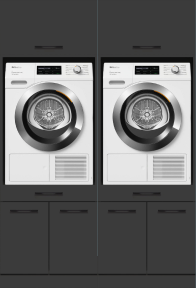
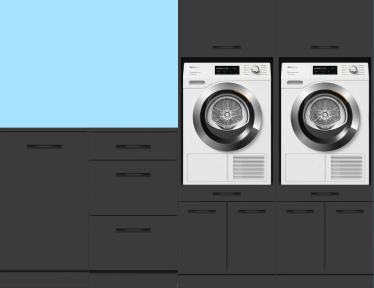
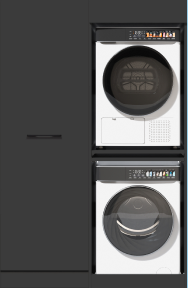
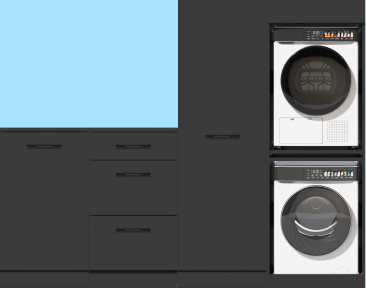
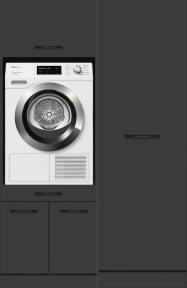
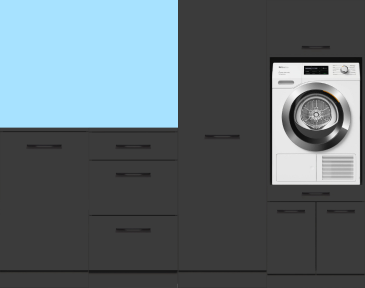
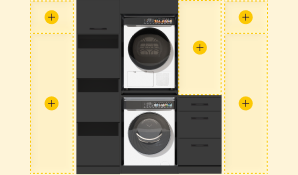
A washing machine cabinet can contribute to a quieter laundry room, but only if it is well constructed. A cabinet that is too light, fits too tightly, or lacks sufficient load capacity can actually start to vibrate along. That’s why a sturdy construction is essential. Wasdroom focuses on robust washing machine cabinets with a load capacity of up to 240 kg (Double) or 120 kg (Single and Stack), precisely to support stability and reduce vibration transmission.
Three things happen simultaneously with a washing machine in a cabinet:
- the machine must stand stable and decoupled;
- the cabinet must not resonate;
- there must be enough space for ventilation and safe use.
This is how you limit resonance of the cabinet and enclosure
A cabinet or enclosure works best if it is solidly built and does not flex unnecessarily. The stiffer and more massive the construction, the less likely panels will vibrate along. It also helps to keep enough free space around the machine so vibrations are not directly transferred to side walls or doors.
- do not place the machine tightly against the cabinet walls;
- ensure a stable platform or sturdy base plate;
- choose a cabinet construction that can support weight well;
- avoid rattling doors, panels, or loose parts.
Reducing airborne noise in a small laundry room
In a compact laundry room, a washing machine often sounds louder because sound reflects off hard surfaces. Think of bare walls, doors, and smooth floors. Sound insulation can help here, but don’t expect a completely soundproof laundry room. The goal is usually to dampen sound and make it less sharp or hollow.
Practically, it works best to limit reflections and resonance. In a closed setup, a heavier door can be beneficial as long as ventilation openings are not blocked. In an open laundry room, it helps to limit hard, hollow-sounding surfaces around the machine.
Which vibration damping solutions in the laundry room really work?
Analyses of competing pages show that users mainly look for practical solutions that can be applied immediately. The most relevant measures are therefore the most concrete: improving stability, decoupling vibrations, and reducing resonance.
Practical solutions at a glance
- Damping mat under the washing machine - helps to limit vibrations reaching the floor, especially if the surface is flat and stable.
- Full base plate instead of separate foot dampers - often more effective on wooden floors due to better weight distribution.
- Level the machine - prevents unnecessary imbalance and extra noise during spinning.
- Keep free space around - prevents direct contact with cabinet walls and reduces transmission of vibrations.
- Use a sturdy washing machine cabinet - helps with stability and limits resonance of the setup.
When a mat is and isn’t enough
A sound-damping or vibration-damping mat can certainly help, but is not always sufficient as a standalone measure. If you are dealing with an unstable wooden floor, a too light cabinet, or a machine that is not properly adjusted, the effect remains limited. Therefore, see a mat as part of the solution, not automatically as the complete solution. If you are unsure whether a damping mat is needed under your washing machine in a cabinet, it helps to first look at the basic setup.
Safety and ventilation in the laundry room
When making a laundry room quieter, safety should never be compromised. Especially when a washing machine is in a cabinet or niche, there must be enough space for ventilation. A too closed setup can trap heat and moisture, which is unfavorable for both the machine and the room itself.
Therefore, take into account:
- enough clearance around the machine;
- free ventilation openings above or below the setup;
- a cabinet or platform with sufficient load capacity;
- a dry, flat, and easily accessible place for installation.
Common mistakes in soundproofing the laundry room
- Using only a thin foam mat and expecting all the noise to disappear.
- Placing the machine tightly against a wall, cabinet, or pipe.
- Forgetting to level the washing machine.
- Installing vibration dampers while the floor itself is too unstable.
- Choosing a cabinet that is too light or weak for the weight of the machine.
- Sealing ventilation openings in an attempt to make the room soundproof.
Handy checklist for a quieter laundry room
- Level the washing machine completely.
- Check if the floor is flat, firm, and not springy.
- Preferably choose a stable base or damping mat.
- Avoid direct contact with cabinet walls and doors.
- Use a sturdy washing machine cabinet if you want to build the machine in.
- Leave enough ventilation space.
- Test the machine during spinning and listen to where the noise is coming from.
Frequently asked questions about sound insulation and vibration damping in the laundry room
How can I reduce the noise from my washing machine?
Always start with the basics: level the machine, check the floor, and prevent direct contact with walls or cabinet parts. Then add vibration damping with a suitable underlay and limit resonance in the room or cabinet. For more detail, you can read about soundproofing a washing machine in a cabinet.
How can I make my washing machine soundproof?
Making a washing machine completely soundproof is usually not realistic in home situations. What does work is greatly reducing the noise by decoupling vibrations, creating a stable setup, and damping airborne noise in the laundry room.
What helps against a vibrating washing machine?
The combination of leveling, a stable floor, and appropriate vibration damping usually gives the best result. Also check if the machine is not too close to a wall or cabinet and if the load in the drum is well distributed. If you have a built-in machine, also see how you can prevent vibrations and noise in a washing machine cabinet.
Does a damping mat under the washing machine really work?
Yes, a damping mat can help reduce impact noise and vibrations through the floor. The effect is greatest if the surface is level and the machine is properly positioned. On an unstable floor, a mat alone is often not enough.
What can I do about noise nuisance from my neighbor’s washing machine?
If the noise from neighbors comes through the floor or wall, it is often impact noise transmitted through the structure. The most effective solution usually lies at the source: a more stable setup, better vibration damping, or relocating their machine. For your own home, you can explore additional measures, but the result strongly depends on the building construction.
Is a washing machine cabinet suitable for reducing noise in the laundry room?
Yes, provided the cabinet is sturdy enough and well constructed. A robust washing machine cabinet with a high load capacity helps keep the setup stable and limits unwanted resonance. Good ventilation and sufficient free space around the machine also remain important. If the main issue is that the washing machine vibrates inside the cabinet, it’s wise to critically check the setup and the surface underneath as well.
Leave a comment
This site is protected by hCaptcha and the hCaptcha Privacy Policy and Terms of Service apply.