


The best floor under your washing machine is hard, stiff, flat, and water-resistant. Think of concrete, ceramic matte tiles, or an epoxy poured floor. Such floors limit vibrations and walking noise, reduce sound, and resist moisture and leaks. Do you have a resilient or smooth floor? With a few practical solutions, you can still make your laundry room safe and quiet.
Characteristics of a suitable floor
Pay attention to these criteria when choosing or assessing the floor under your washing machine:
- Stiffness and load-bearing capacity – minimal deflection under load.
- Flatness and levelness – prevents wobbling and walking during spinning.
- Grip and friction – matte, non-slip top layer helps prevent shifting.
- Water and moisture resistance – resistant to condensation, spills, and possible leaks.
- Sound reduction – hard, solid floors transmit less resonance.
Suitable and less suitable floors at a glance
| Floor type | Suitability | Why | Tip |
|---|---|---|---|
| Concrete | Best choice | Very stiff, solid, and flat | Check for completely level installation |
| Ceramic matte tiles | Very suitable | Hard base, good grip | Choose matte tiles and strong adhesion |
| Epoxy poured floor | Very suitable | Seamless, waterproof, stiff | Have professionally installed with sufficient thickness |
| Glued PVC | Suitable | Water-resistant, fairly stiff | Avoid thick, springy underlayers |
| Click PVC with underlayment | Less suitable | Underlayer springs, increases vibrations | Use a solid intermediate plate or concrete tile |
| Laminate | Less suitable | Springy and moisture-sensitive | Only with extra reinforcement and leak protection |
| Wooden floor | Less suitable | Springy and affected by moisture | Reinforce locally and place a heavy tile |
| Carpet | Unsuitable | Unstable and moisture-absorbing | Always place on a hard, flat base |
| Glossy, smooth tiles | Less suitable | Little grip, risk of walking | Use anti-slip or a concrete tile |
What do you place under a washing machine on a less suitable floor?
Is your washing machine on laminate, wood, carpet, or a springy subfloor? Here's how to make the setup more stable:
Place a heavy, rigid concrete tile of at least 60x60 cm and 3 cm thick under the machine. This increases the contact surface, adds mass, and distributes the load, reducing vibrations and movement. Place the machine directly on the tile and level all feet with equal pressure. Replace worn rubber feet immediately. Want to place the machine more ergonomically and stably? Then consider washing machine risers.
A sturdy anti-slip layer between tile and floor can help on slippery tiles. Do not use vibration dampers in combination with a drip tray under the washing machine, as this becomes unstable. If you have the space, moving to a more massive floor like concrete or matte tiles is the best structural solution.
Vibration dampers: to use or not to use?
Vibration dampers can be helpful for older machines with hard or worn feet, or when you need a bit more grip. On resilient floors, they often do not solve the core problem and can even increase wobbling.
Use dampers only on a hard, flat surface and choose compact, sturdy rubber dampers with sufficient load capacity. Do not combine them with a drip tray or thick, springy underlays. If the machine keeps running or making noise, first check the basics: is it level, are the feet evenly loaded, is the drum properly unpacked, and is the laundry evenly distributed? Dampers are a tool, not a miracle cure.
Smarter choice: balance system and washing machine cabinet
Washing machine with active balance system
Newer washing machines have balance systems that detect imbalance and adjust the spin speed. This reduces vibrations, especially on hard floors. When purchasing, pay attention to specifications about drum balance, noise levels, and maximum spin speed that you really need for your floor and home.
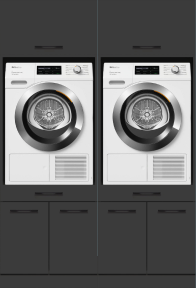
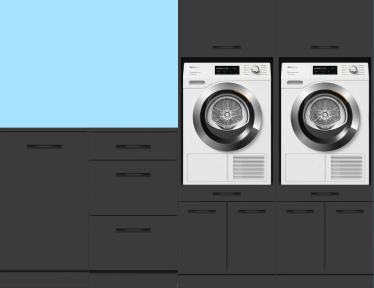
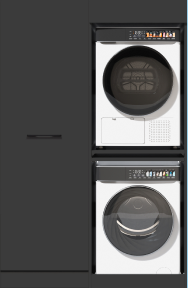
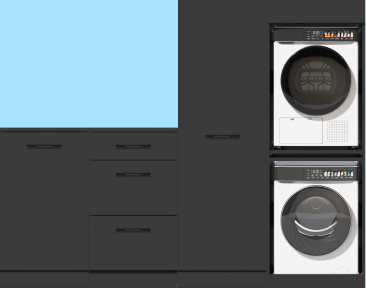
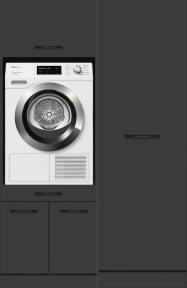
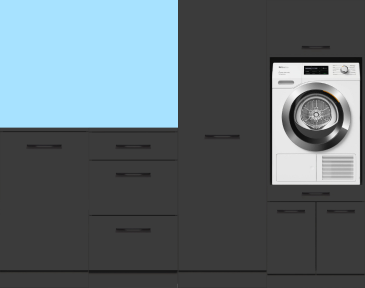
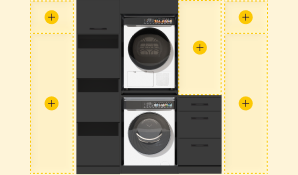
Stability with a washing machine cabinet
A quality washing machine cabinet helps with a solid setup, especially when stacking. Wasdroom cabinets are made of sturdy chipboard with melamine, have soft-close, and are designed to absorb vibrations with a load capacity up to 240 kg (Double) or 120 kg (Single and Stack). Important: a cabinet improves placement but does not replace a stable floor. The base must always be flat, hard, and water-resistant. Placing the machine in a cabinet? Follow this step-by-step plan for placing a washing machine in a cabinet. Also check out washing machine base cabinets for a sturdy foundation.
Practical checklist for a stable placement
Placing it in a cabinet? Go through this washing machine cabinet installation checklist beforehand to ensure load capacity and flatness are correct.
- Choose a hard, flat, water-resistant floor or place a heavy concrete tile.
- Level the machine exactly with all feet applying equal pressure.
- Check and replace worn rubber feet.
- Use dampers only on hard floors, not with a drip tray.
- Avoid springy underlays and smooth, glossy top layers.
- Ensure short, stable hoses and a flat setup without play.
Frequently Asked Questions
What is the best floor under the washing machine?
Concrete, matte ceramic tiles, and epoxy perform best. These floors are stiff, flat, and water-resistant, reducing vibrations, noise, and foot traffic impact. Glued PVC is also possible, provided there is no springy underlay. Click systems with underlay, laminate, wood, and carpet are less suitable.
What is best to place under the washing machine?
A concrete tile of at least 60x60x3 cm is an effective, affordable solution on springy or slippery floors. Adjust the feet precisely and replace worn rubbers. Use vibration dampers only on hard floors and never together with a drip tray.
What is the best floor for a laundry room?
Choose a hard, water-resistant, and low-maintenance floor: concrete, matte ceramic tiles, or an epoxy resin floor. Glued PVC can also work well in many situations. Avoid carpet and sensitive floors like wood or laminate, or reinforce locally with a concrete tile.

