

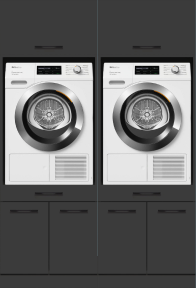
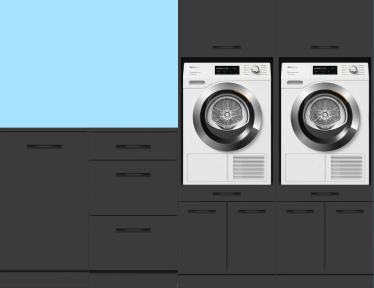
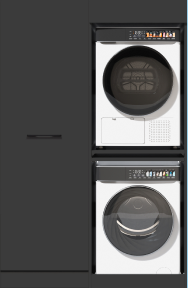
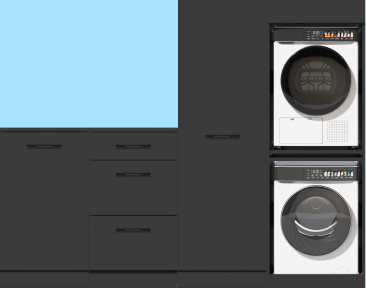
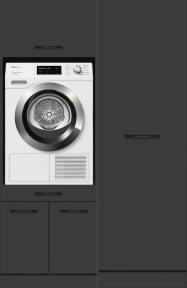
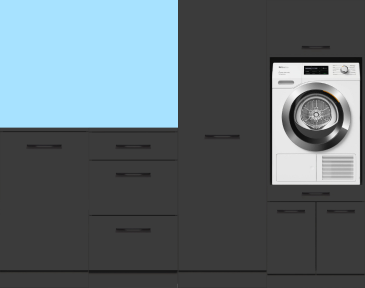
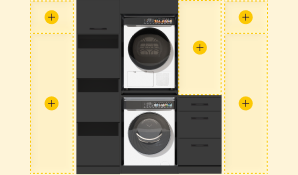

Placing a washing machine in a closed cabinet immediately gives your laundry space a tidy look, less dust, and a sleek interior. But it must remain safe, quiet, and practical. In this guide, you’ll find exactly what you need: the right ventilation, recommended dimensions and free space, solutions for noise and vibration, water and electricity, plus a short step-by-step plan. This way, you create a durable and quiet closed washing machine cabinet that you’ll enjoy for a long time.
Ventilation and safety in a closed cabinet
Heat and moisture must be able to escape from a closed cabinet, otherwise you get condensation, increased wear, or malfunctions. Always ensure air intake at the bottom and exhaust at the top. Use a rule of thumb of at least 150 to 200 cm2 free passage per ventilation point. This can be done with a 1 to 2 cm gap under the door and a grille at the top, or with two ventilation grilles in the door or side panels. Also read the ventilation for a washing machine cabinet for guidelines and examples. Want to get practical? Follow the step-by-step plan to install ventilation in your cabinet.
- Leave 5 to 10 cm free behind the appliances for hoses and air circulation.
- Add extra ventilation for a dryer. A heat pump dryer emits less heat and is therefore more suitable in a closed cabinet.
- Open the cabinet door after a wash or dry cycle so residual moisture can escape.
- Avoid completely airtight sealing with draft strips around; a little air leakage is desired.
- Regularly check for condensation or musty odors and increase ventilation if necessary.
Tip: use moisture-resistant, vibration-absorbing cabinet materials. TÜV-certified cabinet systems are tested for safety and load capacity, providing extra assurance.
Dimensions and free space
Most washing machines and dryers are about 60 cm wide. Depth varies more often, from 56 to 66 cm excluding hoses and plug. Always allow extra margin for hoses, vibration, and ventilation. The guidelines below help you choose a suitable niche size.
| Setup | Min. niche width | Min. niche depth | Free space around |
|---|---|---|---|
| Single appliance | 64 cm | 70 cm | 2 cm per side, 5-10 cm behind |
| Stacked (washer + dryer) | 64 cm | 72-75 cm | 2 cm per side, 5-10 cm at the back, 5 cm above |
| Side by side (2 appliances) | 128 cm | 70-75 cm | 2 cm per side, 5-10 cm behind |
Pay attention to the door swing of the cabinet and appliance doors. When placing side by side, a worktop at 90-100 cm height is practical. Always check your appliance manuals and adjust the niche size if your machine is deeper or wider than average. Also read: Placing a washing machine behind a cabinet door.
Noise reduction and vibrations
Cabinet walls can resonate, especially at high speeds. Damping and stable placement help the most. Level the washing machine perfectly and use a sturdy, flat floor. An anti-vibration mat under the machine and a solid base plate reduce transmission to the cabinet. Secure a stacked setup with a coupling piece or a specially designed cabinet frame and anchor to the wall where required. Read detailed tips for soundproofing a washing machine in a cabinet.
- Limit overloading and unbalanced drum loads.
- Check and readjust leveling feet after transport or relocation.
- Consider a lower spin speed in the evening or at night.
- Do not leave loose items on the cabinet worktop that can vibrate along.
Water and electricity
Water and drainage
Install an easily accessible shut-off valve and a drip tray under the washing machine in a cabinet. Ensure a drain with a siphon and secure hoses to prevent disconnection. Leave space behind the machine so hoses don’t kink. Check for leaks after installation and replace old hoses preventively.
Electricity and load capacity
Use a grounded outlet on a 16A circuit and avoid power strips or extension cords. Keep cables free from pinch points and moisture. When building, account for the actual weight: a washing machine often weighs 60-80 kg, and with water and laundry, it can be heavier; a dryer weighs 40-60 kg. Use a cabinet with sufficient load capacity and, where required, wall brackets. Systems certified by TÜV that support up to 240 kg (Double) or 120 kg (Single and Stack) per cabinet offer extra security.
Choosing the right enclosed cabinet
A closed cabinet for washing machine and dryer must be moisture-resistant, absorb vibrations, and safely support heavy weight. At Wasdroom, you’ll find series for every situation: Single for one appliance, Double for side-by-side, and Stack for a stacked set. The cabinets are designed for plug-in installation, have a load capacity of up to 240 kg (Double) or 120 kg (Single and Stack) per cabinet, and are TÜV-certified. This provides assurance for intensive use in humid spaces. See all closed washing machine cabinets.
Looking for a closed washing machine cabinet that looks sleek and is practical? Models like the Wasdroom Double 1.0 or Double 5.0 offer lockable doors, neat cable and hose management, and space for detergents. With a 10-year warranty and materials resistant to moisture and resonance, you’ll make your laundry space not only more attractive but also quieter and more durable.
Step-by-step plan: from measuring to installation
- Measure the width, depth, and height of the niche and note the dimensions of your appliances.
- Plan ventilation: vents at the bottom and top or in door panels, plus space behind.
- Provide water, drainage, and a grounded outlet in the correct location.
- Assemble and anchor the cabinet according to the manual and check it is level.
- Place the washing machine, adjust the feet, connect hoses and power.
- Run a test wash and check for leaks, vibrations, and adequate airflow.
Frequently Asked Questions
Is it safe to place a washing machine in a cabinet?
Yes, provided you ensure sufficient ventilation, a cabinet with adequate load capacity, and proper water and electrical connections. Preferably use a moisture-resistant, TÜV-tested cabinet, anchor it where necessary, and leave ventilation space around the machine.
How do you get a washing machine into a closed cabinet?
Protect the floor, temporarily remove cabinet doors if that provides more space, and place the machine with two people. Slide it on felt pads or a transport plate, level it, and connect water and electricity. Check hoses for kinks and run a short test cycle.
Can a washing machine fit in a Pax cabinet?
A Pax is designed for clothing, not for heavy, vibrating equipment. Load capacity, ventilation, and moisture resistance are usually insufficient. It’s better to choose a closed washing machine cabinet made and tested for this purpose, such as a TÜV-certified system.
How much space should there be between the washing machine and the cabinet?
Maintain at least 2 cm of free space on both sides and 5 to 10 cm behind the machine for hoses and airflow. When stacking, 5 cm of space above is recommended. Always check the device manual for specific requirements.

