

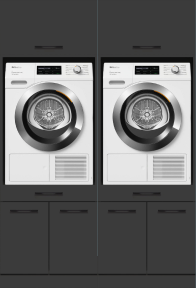
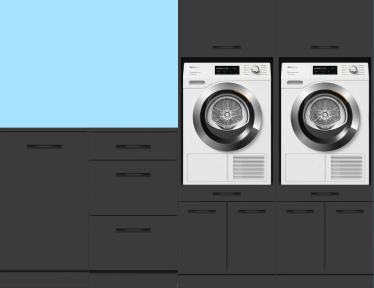
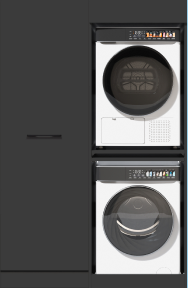
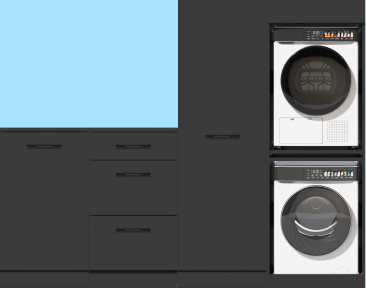
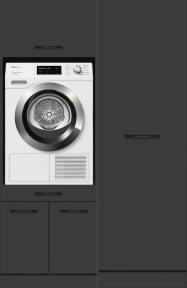
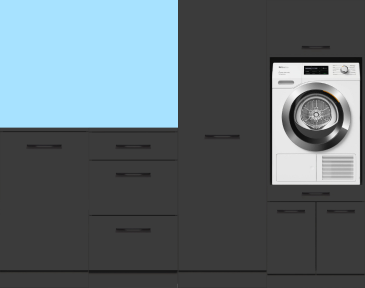
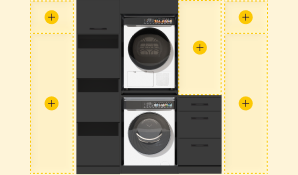

Do you want a sleek laundry setup and are considering a washing machine inside an IKEA METOD cabinet? That’s possible as a casing, not as a supporting structure. The machine must always stand freely on the floor, while the cabinet only conceals and stores it. Ventilation, space for hoses, and vibration damping determine whether your plan works. In this guide, you’ll find a practical approach, exact measurements, and clear pitfalls. First, read the considerations in IKEA washing machine casing hack: pros and cons. Tip: if METOD doesn’t work safely or stably, consider a specially designed washing machine cabinet like Wasdroom Enkel 1.0 or Dubbel 1.0.
IKEA hacks explained: METOD, ENHET, and BESTA
METOD is most suitable as a casing. Leave the back open or partially open for airflow and hoses, work with filler pieces and a countertop for a neat front line, and ensure the cabinet doesn’t lock the machine in anywhere. A dryer on top of the washing machine is only possible with an official stacking kit, where the casing functions as a niche and not as a support. Under a sloped roof, you can make METOD cabinets shallower with filler pieces, as long as the machine remains free on the floor and you can vent warm air at the top. More about the (im)possibilities: Can a washing machine fit in a kitchen cabinet system (like IKEA METOD)?
ENHET offers open frames that easily maintain ventilation. Place the machine in the frame on the floor and use shelves around it for baskets and detergents. Check that the back remains free for the plug, water hose, and drain.
BESTA is generally unsuitable as a METOD washing machine cabinet: the cabinet depth and construction are not designed for the weight, vibrations, and required ventilation. In summary: use METOD or ENHET as casing, never load-bearing, and design so that service access, airflow, and damping are ensured.
Quick step-by-step: casing around your washing machine
- Inventory dimensions: machine width and depth including protruding door, hoses, and plug.
- Draw your niche size with clearance all around and free rear space for air and pipes.
- Remove or move cabinet back panels so hoses and air can circulate.
- Level the cabinet frames and anchor them to the wall for stability, not to the machine.
- Place the washing machine on a sturdy, flat floor with an anti-vibration mat.
- Install a countertop and filler pieces; leave a gap at the front or top for air.
- For a dryer on top: use a stacking kit from the appliance brand, never a cabinet shelf.
- Check service access: filter, tap, plug, and drain must remain reachable.
Want all conditions and steps compactly together? See Placing a washing machine in a kitchen cabinet: what’s allowed and possible.
Ventilation, load capacity, and vibrations
A washing machine produces heat and moisture; without airflow, condensation and risk of mold or malfunctions occur. Therefore, leave the back free and create an air inlet and outlet, for example via a gap or ventilation grille. The cabinet must never bear the weight: during spinning, peak loads and micro-movements occur that can damage screw connections and panels. Place the machine directly on the floor, adjust the feet properly, and use a damping mat to reduce vibrations and contact noise. Secure casing parts firmly to the wall, not to the machine, so nothing resonates along. More guidelines can be found in Ventilation for a washing machine cabinet. Want to know how to safely arrange outlets, circuits, and connection points? See Electricity and water for a washing machine cabinet (outlets and circuits).
Maintain dimensions
- Free space on sides: 2-3 cm per side.
- Free space at back: 5-10 cm for hoses, plug, and air.
- Free space above: 3-5 cm, more if stacking a dryer.
- Niche width: usually 64-68 cm for machines about 60 cm wide.
- Niche depth: preferably 70 cm or more; METOD carcasses of 60 cm are often tight for hoses and plug.
- When stacking, always use a stacking kit from the appliance brand.
Unsure if you have enough depth or ventilation with a washing machine in a METOD cabinet? Then check Depth of washing machine and dryer: which cabinet fits?. Then choose a specially designed cabinet solution.
Can you place a washing machine in an IKEA cabinet?
Yes, but only as a casing. The washing machine must remain free-standing on the floor and may not rest on shelves or floating frames. Ensure sufficient ventilation and service access. Kitchen cabinets are not designed as a supporting structure for rotating mass with vibrations. For maximum stability, moisture resistance, and noise reduction, a dedicated washing machine cabinet like Wasdroom Enkel 1.0 or Dubbel 1.0 is safer and more practical.
Frequently Asked Questions
Can a washing machine fit in an IKEA PAX cabinet?
PAX is a wardrobe and not suitable for the weight, depth, and vibrations of a washing machine. So do not use PAX as a supporting structure. Choose a casing with an open back and always place the machine on the floor.
How big should a cabinet be for a washing machine?
Plan for a niche about 64-68 cm wide, 70 cm deep, and at least 90 cm high, plus 2-3 cm side clearance and 5-10 cm rear space. This keeps hoses, plug, and ventilation free.
Can all appliances fit in an IKEA kitchen?
Many built-in appliances fit, but a washing machine is not a standard kitchen appliance. Treat it as a freestanding appliance within a casing. Always check the specifications of the appliance and cabinet for dimensions, ventilation, and mounting.

