

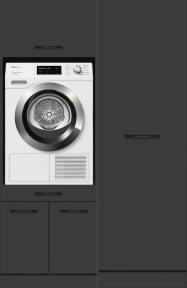
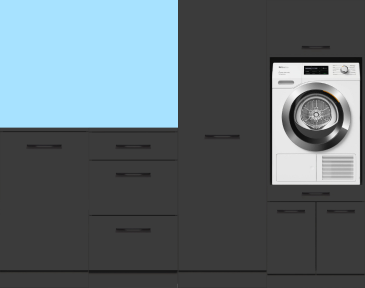

Neatly concealing a freestanding washing machine behind a cabinet door is perfectly doable, especially with suitable washing machine cabinets, as long as you properly manage the technical and practical details. Consider ventilation, sufficient clearance around the machine, vibration damping, and accessibility of the filter. This guide provides a clear step-by-step plan, tips for special situations such as a low filter flap, and selection help for side-by-side or stacked setups. This way, you can turn your laundry room, utility room, or bathroom into a sleek, quiet, and safe place to do laundry.
Safety, ventilation, and dimensions: the prerequisites
For a washing machine in a cabinet, air circulation, free space, and stability are crucial. For most machines, allow about 60 cm width and 56-65 cm depth. Leave clearance around for vibration and cooling, and ensure the plug, tap, and drain remain easily accessible. A flat, sturdy floor and leveling reduce noise and movement. Use damping pads where possible. When stacking, always place the dryer on top with a suitable spacer. More practical guidelines for layout, ventilation, and ergonomics can be found in setting up a laundry room.
| Aspect | Advice |
|---|---|
| Side clearance | 2-3 cm per side |
| Rear clearance | 5-10 cm for hoses and plug |
| Front clearance | Door can open fully, removable plinth |
| Ventilation | Air vents at the bottom and top of the cabinet door/plinth |
Also pay attention to your cabinet’s load capacity. Heavy, rotating masses require a rigid structure that absorbs vibrations. For ready-made cabinets, a TÜV certification and high load capacity are reassuring indicators that this is well addressed.
Step-by-step plan: concealing a standard washing machine behind a cabinet door
- Preparation: measure the appliance, niche, and door precisely. Check where water, drain, and power enter and plan service access for the filter and tap.
- Floor and stability: lay a stable, flat base. Level the washing machine using the adjustable feet. Optionally place an anti-slip mat or dampers.
- Positioning: slide the machine into the cabinet with the planned side and rear clearance. Ensure sufficient door passage and hose bends without kinks.
- Provide ventilation: create ventilation openings in the plinth and at the top of the door or side panel. If necessary, install grilles for a neat finish. See also the manuals for guidelines and installation order.
- Front and hinges: install a front frame or mount the cabinet door. Check door thickness, hinge position, and that the door swings freely without touching the machine.
- Vibration check: connect water and drain, run a short spin cycle, and check clearance and noise level. Fix or stiffen panels where needed.
- Finishing: neatly conceal seams and cables with clips or cable ducts. Label the main valve and ensure a removable plinth for maintenance.
Special situations: low filter flap and accessibility
For machines with a low filter flap, a fixed plinth quickly gets in the way. Therefore, make the bottom strip removable so you can easily access the filter.
- Mount a loose plinth on small angle brackets or magnetic closures so you can remove it without tools.
- Use wing nuts or snap connectors to secure the plinth during washing but still allow quick removal.
- Leave 2-3 cm extra space between the bottom strip and machine front for the hinged filter flap.
- Place the emergency drain hose accessible behind the plinth and test opening and closing before finishing the cabinet permanently.
- Alternative: create a service hatch exactly at the filter height, finished with a ventilation grille.
Tip: if the detergent drawer is less accessible through the door, you can dose liquid detergent directly into the drum according to your detergent’s instructions. Is the space just too tight or do you want to integrate a service hatch? See how to combine separate cabinets into the setup that fits your space.
Setups: side-by-side, stacked, or double
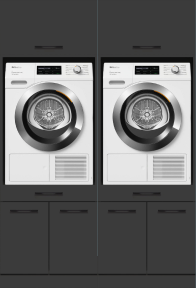
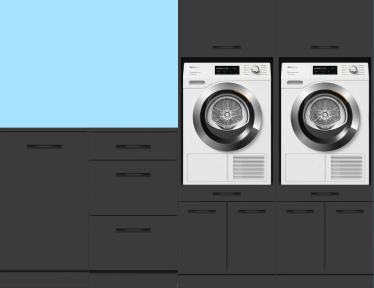
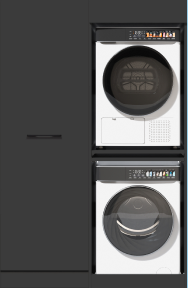
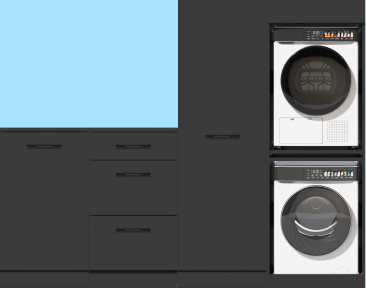
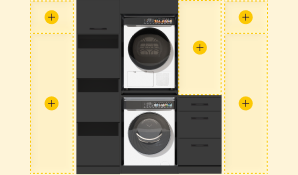
Side-by-side is convenient if you want a worktop above the appliances. Stacking saves floor space and is ideal in a narrow niche. Always use a spacer or stacking kit that fits the brands and sizes, and choose a construction that directs the forces stably to the floor. A double cabinet with doors keeps everything out of sight, provides storage for detergents, and makes it easier to integrate ventilation and vibration damping.
Ready-made solution: Wasdroom cabinets and configurator
If you don’t want custom carpentry but want a neat and safe built-in solution, Wasdroom cabinets make it easy. The Single Series are perfect for one appliance, the Double Series combine washing machine and dryer side-by-side with storage space, and the Stack Series stack compactly with the dryer on top. All models are designed to absorb vibrations, have a load capacity up to 240 kg (Double) or 120 kg (Single and Stack), are TÜV-certified, and thanks to the plug-and-play assembly system, can be quickly installed yourself. Via the My Configurator you can put together your own combination, with delivery in the Netherlands and Belgium and a 10-year warranty.
Frequently Asked Questions
Is it allowed to place a standard washing machine fully inside a cabinet?
Yes, provided you maintain sufficient ventilation and clearance and keep service points (filter, tap, plug) accessible. Provide air holes at the bottom and top, leave 2-3 cm side clearance and 5-10 cm rear clearance, and ensure a stable, level setup that can absorb vibrations.
How do you prevent vibrations and noise in a washing machine cabinet?
Level the machine, use anti-slip mats or vibration dampers, and stiffen the cabinet structure where needed. Anchor long side panels, keep the door clear of the drum, and check for contact points during spinning. A cabinet with a damping construction helps noticeably.
Can the dryer be placed on top of the washing machine in a cabinet?
Yes, but always place the dryer on top with a suitable spacer or stacking kit. Maintain ventilation space around, arrange condensate or water drainage according to the dryer manual, and check that the cabinet transfers the stacking load stably to the floor.

