


A cabinet above your washing machine seems like the ultimate space saver. But how much space do you really gain, and what should you consider for safety, ventilation, and installation? This guide provides practical tips to help you make the best choice for your laundry area—including alternatives that are often even smarter in practice.
What does a cabinet above your washing machine offer?
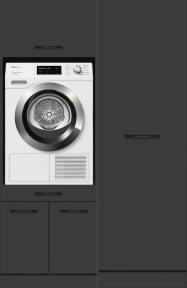
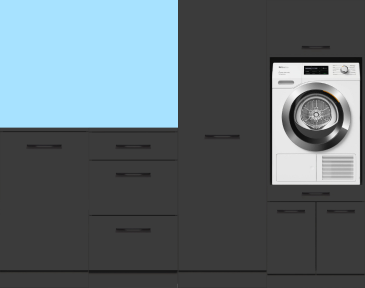
With a cabinet above the washing machine, you utilize vertical space instead of floor space. Your footprint doesn’t change, but you add vertical storage for detergent, laundry baskets, and towels. For a standard washing machine, expect about 85 cm appliance height plus an additional 60 to 100 cm of cabinet space above. This way, you create 200 to 300 liters of storage without adding any extra floor space. If you want to smartly use both height and width, consider a cabinet wall for laundry rooms.
Pay attention to door swing, walkways, and ceiling height. In narrow laundry corners, a shallow upper cabinet or open shelves are often more practical than deep cabinets with doors. For ergonomics, a middle shelf at about 90 to 105 cm is convenient as a temporary spot for your laundry basket. Also, leave 8 to 10 cm clearance behind the cabinet for siphons, drains, and cords so your appliances don’t get stuck.
Safety, load capacity, and ventilation
Safety is paramount in a damp, vibration-prone space. Choose a construction with wall brackets and a tilt lock to prevent the cabinet from tipping forward during spinning. Adjustable feet help level the cabinet and dampen vibrations. For load capacity, 120 to 240 kg is a common guideline for sturdy washing machine cabinets—more than enough for a fully loaded washing machine and extra storage items.
Material choice is crucial. Moisture-resistant plywood or well-sealed MDF with finished edges is suitable; unfinished particleboard swells quickly. Finish edges with PU glue or edge banding and avoid open gaps where condensation can enter. Always ensure air circulation: a ventilation grille in or above the cabinet and free space behind the appliances help dissipate heat and moisture. Read more about ventilation for a washing machine cabinet. Check in advance how much free space above the washing machine in a cabinet is needed for safe installation. Also, leave a few centimeters of clearance around the machine for fit and cooling.
Installation and sizing: how to avoid bad purchases
Work systematically with this checklist for a proper installation:
- Measure width, depth, and free height to the ceiling. Add 8 to 10 cm extra depth for hose and cord space.
- Check where the water tap, drain, and outlets are located and plan cutouts in the back panel.
- Determine the wall type and choose appropriate anchors. Attach with multiple wall brackets at load-bearing points.
- Level the cabinet with adjustable feet and use vibration dampers under the machine.
- Leave 1 to 2 cm clearance around the machine and do not block service panels or filters.
- Provide a shelf or worktop at about 90 to 105 cm for ergonomic loading and unloading.
Measuring for the first time? Follow step-by-step: Measuring yourself for a washing machine cabinet. Want to design a complete solution? Read the guide Assembling a cabinet wall for the laundry room.
Alternatives that often save more space
In many situations, you gain more with a different setup than a cabinet above the washing machine:
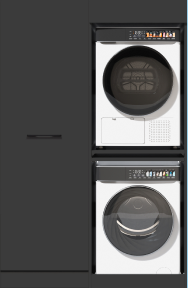
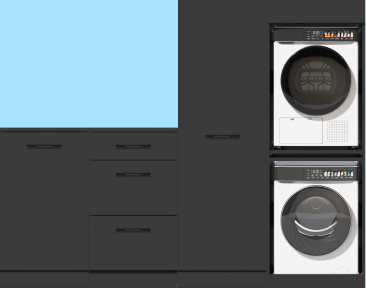
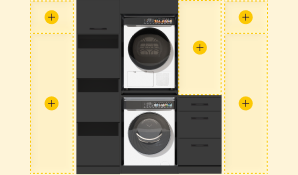
- Stacked washing machine + dryer: compact footprint, better ergonomics with a middle shelf, often frees up the most floor space.
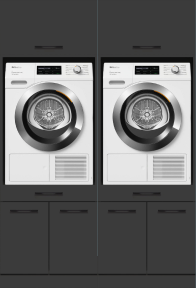
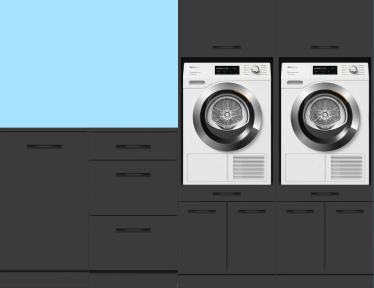
- Side-by-side with worktop and upper cabinets: maximizes workspace and storage volume, ideal in wider niches. A double washing machine cabinet with upper cabinets uses both width and height.
Since Wasdroom does not offer specific above-washing-machine cabinets, a stacked or double setup usually fits best with our solutions and delivers the most gain per m2 in practice. Also check out our built-in cabinets for washing machine and dryer for integrated setups that optimally use floor and wall space.
Frequently Asked Questions
Is a cabinet above the washing machine safe?
Yes, provided you anchor it with wall brackets, choose sufficient load capacity, and allow space for ventilation. Use adjustable feet and dampers to absorb vibrations and prevent tipping with a tilt lock.
How much space do I need behind the cabinet for pipes?
Allow 8 to 10 cm for drain, water supply, and power cables. Also leave a few centimeters of air around the appliance for cooling and condensation drainage.
