

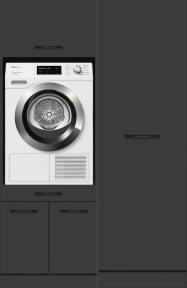
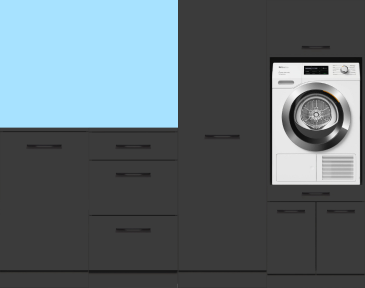

Placing a washing machine behind a cabinet door looks sleek and tidy. But it requires more than just a nice front panel. Heat, moisture, and vibrations need to be able to escape, maintenance points must remain accessible, and you want to avoid issues with warranty or extra risk of damage. In this article, you’ll get a straightforward checklist of do’s and don’ts, plus a safe alternative that offers the same calm look without compromising ventilation, ergonomics, or lifespan.
What you really need to know about ventilation, safety, and warranty
A freestanding washing machine is not designed as a true built-in appliance. If you put a cabinet door in front of it, you quickly limit airflow and service access. During washing, heat and moisture are released, and during spinning, vibrations increase. A closed or poorly ventilated cabinet can trap heat, amplify noise, and build up condensation, risking malfunction, wear, or in extreme cases, fire hazard. Many manufacturers therefore advise placing appliances freely with enough space around them and unobstructed air circulation.
Also pay attention to warranty conditions: if a manufacturer explicitly requires free placement and ventilation, a closed cabinet with a door may conflict with those terms. In practice, this means you must keep the door open during use for air intake and exhaust. This is less practical and not ideal for safety in a narrow passage. Therefore, consider whether your goal—sleek and calm—is better achieved with a well-designed open washing machine cabinet with panels that allow air flow, dampen vibrations, and keep maintenance points accessible.
Still want a cabinet door? Here’s how to minimize risks
If you choose a cabinet door anyway, approach it thoughtfully. Always follow your appliance manuals and work safely. See also our installation and assembly manuals for practical placement steps.
- Preparation: measure the niche precisely, check water supply, drainage, grounded outlet, and preferably place a drip tray.
- Construction: build with stable side panels and a front frame set slightly back so the appliance door can open freely and the cabinet door doesn’t hit the handle.
- Ventilation: create openings low and high in the cabinet for air intake and exhaust. Keep the cabinet door open during use.
- Access: make the bottom strip removable so you can reach the lint filter or emergency drain flap. Keep the tap and siphon accessible.
- Vibrations: level the machine, use a spacer when stacking, and consider vibration dampers. Secure panels firmly.
- Safety: install a smoke detector near the setup and regularly check for moisture or leaks.
If you doubt the load-bearing capacity or sturdiness of your enclosure, have the construction checked by a professional.
Placement options and ergonomics
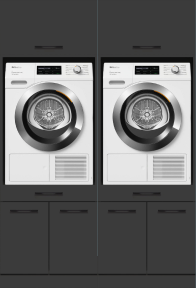
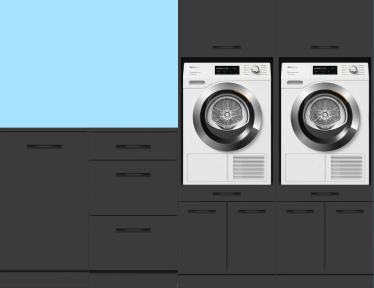
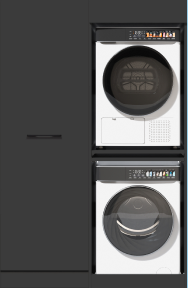
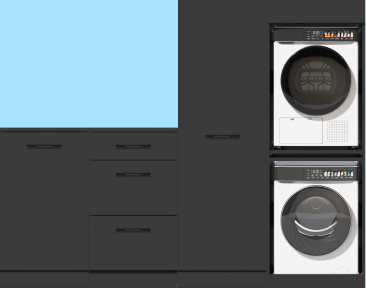
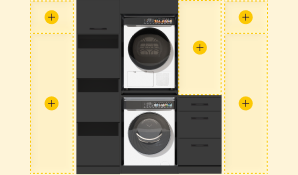
If you have limited space, stacking is a strong choice: the dryer should always be on top, and you use a suitable spacer from the manufacturer. If you place appliances side by side, consider a worktop at a comfortable height for sorting and folding. In a utility room, kitchen, or niche: ensure a flat surface, free air around, and enough space for hoses, plug, and vibration. A niche width of about 60 cm per appliance is common; always check the actual dimensions of your appliances including clearance for cables and hoses. For a neat side-by-side setup, the Double Series is a suitable choice.
Maintenance and accessibility
A cabinet door should never get in the way of routine tasks. You want quick access to the lint filter, tap, and siphon, and to dose detergent neatly without spilling. Also consider cleaning the door seal, removing soap residues, and checking hoses for wear. The easier the access, the longer and more trouble-free your equipment will last.
Smart alternative without doors: open washing machine cabinet
If you want a calm, integrated look without the downsides of a closed cabinet, an open washing machine cabinet is a future-proof solution. At Wasdroom, you can choose from the Single Series, Stack Series, or Double Series—stylish cabinets with high load capacity up to 240 kg (Double) or 120 kg (Single and Stack), TÜV-certified and designed to absorb vibrations. Thanks to thoughtful panels and ventilation, airflow remains optimal and maintenance points stay accessible. You can easily configure your cabinet in our configurator to fit your space and workflow, and benefit from a 10-year warranty. This way, you combine the sleek look of an enclosure with safety, ergonomics, and ease of use.
Design your open washing machine cabinet in the configurator
Frequently Asked Questions
Can you install a washing machine behind a cabinet door?
A washing machine is generally not a built-in appliance. Manufacturers require free air circulation and service access. If you do install a cabinet door, ensure generous ventilation and keep the door open during use. An open washing machine cabinet is often a safer choice.
How much ventilation does a washing machine cabinet need?
It varies per appliance. In any case, provide air intake low in the cabinet and exhaust high, and prevent heat and moisture from being trapped. Always follow your machine’s manual. Using a cabinet door closed increases the risk of heat buildup.
Can a heat pump dryer be placed behind a cabinet door?
A heat pump dryer also emits heat and moisture. In a closed cabinet, extra ventilation is crucial and the door must be kept open during use. In practice, an open cabinet with a spacer on top of the washing machine works safest and most practically.

