


Do you want to connect a washing machine and dryer to the same circuit? Basically, NEN 1010 requires that large consumers each have their own final circuit. However, there are situations where you can manage safely with only one line or circuit available. Below you can read what the standard says, where things can go wrong, and which options are safe. Also read more about sockets and circuits in the washing machine cabinet. Do not confuse the electrical circuit with the drain; you can read about that in washing machine and dryer on the same drain.
What NEN 1010 says in brief
NEN 1010 is the installation standard for low-voltage installations. A practical rule of thumb from it: devices with a power above 2000 watts should have their own final circuit. A standard final circuit is 16A at 230V and can deliver about 3600 watts. Because washing machines and dryers often exceed 2000 watts, the starting point is that they each need a separate circuit. This limits overload, voltage drop, and unwanted shutdowns.
Why sharing one circuit is usually not a good idea
A 16A circuit can handle about 3600 watts. A washing machine typically consumes 2000 to 2300 watts during heating, depending on the program. A dryer quickly uses between 2000 and 3000 watts. When both devices heat simultaneously, you exceed the circuit capacity and the breaker trips. Additionally, there are startup peaks that cause extra load. A double socket does not help – it remains the same circuit. Read how to safely install a socket in the washing machine cabinet. Apart from comfort and malfunctions, you also risk damage if the installation is not compliant with the standard.
Safe options when you have limited circuits
Install two separate final circuits
This is the best and most future-proof solution. Your washing machine and dryer each get their own 16A final circuit with grounding, according to NEN 1010. This allows you to use both devices simultaneously without unnecessary shutdowns or overload. During renovation, this is the perfect time to plan extra wiring and circuits for large consumers. Optionally use this checklist for installing a washing machine cabinet.
Combination controller or power distributor on one circuit
If you only have one circuit available, an approved combination controller can be a solution. Such a controller monitors power and prevents the washing machine and dryer from demanding peak power simultaneously. One device gets priority, the other waits or pauses automatically. It is important that the solution is certified and professionally installed. Realize that your devices cannot run at full power simultaneously – that is exactly the safety function. Also check whether water and electricity meet the requirements for a washing machine cabinet.
Cooker circuit as an alternative in specific cases
A cooker circuit consists of two mechanically linked 16A breakers. In some situations, installers choose such a linked double final circuit to supply two heavy consumers separately. This can be a safe route provided it is fully designed and installed according to NEN 1010, including proper wiring, sockets, and protections. Always have this assessed and carried out by a certified electrician – it is custom work and not applicable in every home.
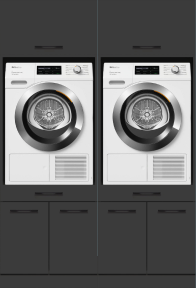
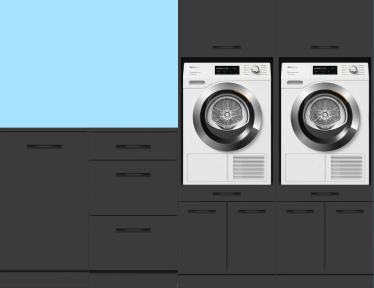
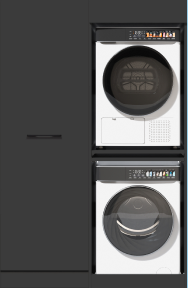
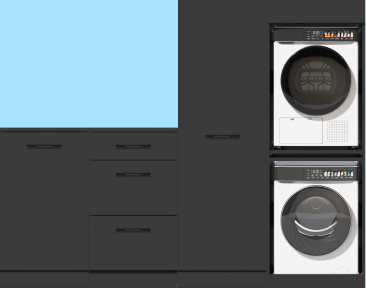
If you place the devices in one cabinet, pay attention to ventilation, vibration, weight, and the shareable power on the circuit(s). For practical steps see Connecting a washing machine in a cabinet. If you prefer to place them separately but compactly, check the considerations for washing machine and dryer side by side in a cabinet.
Frequently Asked Questions
Can a washing machine and dryer be on one circuit?
In principle, it is not desirable because both are large consumers. According to NEN 1010, each device should have its own final circuit. Only with a certified combination controller that prevents simultaneous peak consumption can you safely use them on one circuit.
Can I connect a washing machine and dryer to the same socket?
A double socket remains one circuit. It seems practical, but with simultaneous use you quickly exceed the approximately 3600 watts of a 16A circuit. Choose two final circuits or an approved combination controller as a temporary solution.
Which devices need a separate circuit?
Rule of thumb: everything above 2000 watts. Think of washing machine, dryer, dishwasher, oven, Quooker, and electric cooktop. This limits overload and ensures your installation complies with the standard.
Why are washer-dryer combos not popular?
They save space but often have longer program durations, lower drying capacity, and more wear due to combined use. Separate devices usually perform better and offer more flexibility in energy use and scheduling.
Are you unsure about your situation or circuit panel? Have your installation checked by a certified electrician. On Wasdroom you will find more practical guides about laundry room setup and electrical safety.

