

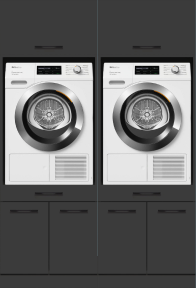
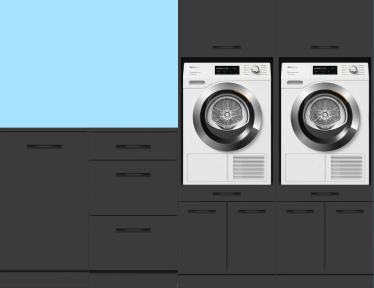
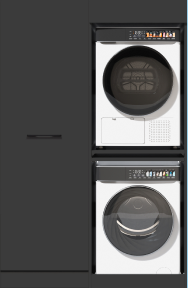
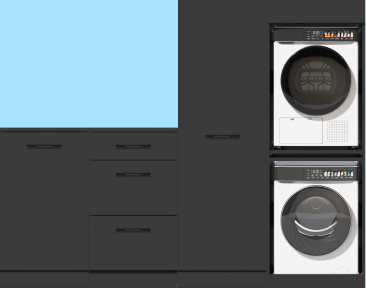
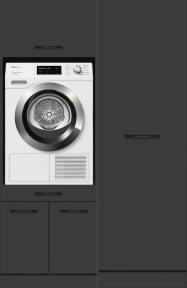
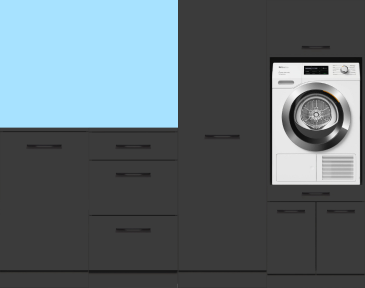
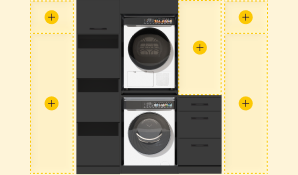

A washing machine cabinet faces weight, moisture, and especially vibrations. The right material and construction determine whether your cabinet remains stable, dampens noise, and protects your equipment. In this guide, you’ll discover which materials absorb vibrations best, which thicknesses work, which construction details matter, and how to install safely for quiet, worry-free laundry cycles. Want to reduce disturbing noise? Read more about preventing vibrations and noise in a washing machine cabinet.
Chipboard vs MDF for a washing machine cabinet
Both chipboard and MDF are popular for washing machine cabinets, but they respond differently to vibrations, moisture, and load. Chipboard consists of wood chips compressed under pressure with resin. The internal structure is slightly less dense than MDF but often works to your advantage with vibrations: the heterogeneous structure and melamine coating help limit resonance and are wear-resistant and hygienic in use. Quality decorative chipboard with the right thicknesses offers high stiffness and good screw retention combined with smart joints.
MDF is homogeneous and denser. This makes it easy to machine precisely and strong in flat parts. It behaves predictably when milling and drilling and has good sound-absorbing properties with sufficient panel thickness. Preferably use moisture-resistant MDF variants in a laundry room, and carefully finish open edges to prevent moisture absorption.
Which is the most vibration-resistant? In practice, it comes down to the combination of material, panel thickness, and construction. A washing machine cabinet made of sturdy decorative chipboard with melamine, built with sufficient panel thicknesses and stable joints, effectively dampens vibrations and remains dimensionally stable. MDF can deliver similar performance when you choose thicker boards and moisture-resistant quality, but it is heavier and requires more attention to edge finishing.
Practical guidelines for panels and shelves in a vibration-sensitive setup:
- Side and intermediate panels: 18-22 mm for stiffness and screw retention.
- Top panel and support platform under the machine: 25-30 mm for deflection control and damping.
- Use high-quality joints and cross braces to prevent racking.
- Precise leveling: adjust legs to be perfectly level so forces are transmitted perpendicularly.
Wasdroom uses sturdy decorative chipboard with melamine coating in TÜV-certified constructions with a load capacity of up to 240 kg (Double) or 120 kg (Single and Stack) per cabinet. This combination of material and build quality minimizes vibrations and increases user safety.
Damping vibrations: material and construction work together
Vibration resistance is never just a matter of materials. Here’s how to get the most out of your cabinet:
- Stiffness where needed, damping where it counts: thicker panels for load-bearing parts, melamine-coated surfaces for wear resistance and reduced resonance.
- Fixed coupling: anchor the cabinet with wall brackets to prevent sliding and tipping.
- Precise leveling: adjust legs to be perfectly level so forces are transmitted perpendicularly.
- Machine decoupling: use rubber vibration dampers or an anti-slip mat under the feet.
- Thoughtful layout: extra partitions and back panels increase torsional stiffness and limit cabinet deformation.
Want to mainly reduce noise levels? Check out our explanation on noise damping for washing machines in a cabinet.
Shock absorbers and transport bolts
If your machine keeps vibrating strongly, first check the transport bolts. If they haven’t been removed, the drum can’t move freely, causing extreme vibrations. Also, shock absorbers inside the machine wear out after years of use. Defective shock absorbers increase the load on every cabinet. Always remove the transport bolts according to the manual, and if imbalance persists, have the shock absorbers checked. Only then can you further optimize the cabinet with leveling and dampers. Finally, consider whether a damping mat is needed for a washing machine in a cabinet as an additional measure.
Load capacity, safety, and certification
A safe washing machine cabinet combines high load capacity with stable anchoring and controlled movement. Look for a tested load capacity that suits the weight of your washing machine and dryer, sturdy couplings, cross braces, and included wall brackets. Adjustable legs allow for precise leveling, reducing shock transmission. An independent test or certification, such as TÜV, provides extra assurance that the construction can withstand dynamic loads and long-term use. Unsure about your floor’s load capacity? Read when and how to reinforce your floor for a washing machine cabinet.
Wasdroom cabinets are TÜV-certified, support up to 240 kg (Double) or 120 kg (Single and Stack) per cabinet, and come with adjustable legs and soft-close systems for soft and quiet closing. The melamine top layer is wear-resistant and easy to clean. Thanks to the plug-in assembly system, you can build quickly and precisely, and with a 10-year warranty and support in the Netherlands and Belgium, you have long-term assurance.
Overview of materials for washing machine cabinets
The summary below helps you quickly choose the right material for your situation and use.
| Material | Vibration resistance | Moisture resistance | Points of attention |
|---|---|---|---|
| Decorative chipboard with melamine | Good damping with proper thickness and construction | Melamine is wear-resistant and easy to clean | Choose 18-22 mm walls, 25-30 mm load-bearing parts |
| Moisture-resistant MDF | Good, especially with thicker panels | Use MV variant, finish edges well | Relatively heavy, attach carefully |
| Plywood/underlayment | Rigid and strong, less damping | Finish against moisture, seal seams | Combine with dampers to limit resonance |
Frequently Asked Questions
How thick should MDF be for a washing machine cabinet?
Go for 18-22 mm for side and intermediate panels and 25-30 mm for load-bearing parts like the platform under the machine or countertop. Prefer moisture-resistant MDF in a laundry room and carefully finish all edges for durable moisture protection.
Which cabinet to use under a washing machine?
Choose a specially designed washing machine cabinet with tested load capacity, adjustable feet, and wall brackets. Models like the Wasdroom Single or Stack offer stability and vibration damping. Pay attention to material and panel thicknesses and combine with rubber feet or anti-slip mats. Not sure what to put under the machine? See what to put under a washing machine in a cabinet.
Is it safe to place a washing machine inside a cabinet?
Yes, provided the cabinet has sufficient load capacity, is well anchored, and the machine is level. Ensure ventilation around it and keep hoses and cables free. A TÜV-tested cabinet with adjustable feet and wall brackets, like Wasdroom’s, increases safety.
How much space should be between the washing machine and the wall?
Usually leave 2-5 cm free for hoses, cables, and air circulation. Check your machine’s manual for exact clearances. Placing it too tight can increase vibrations and noise and shorten the lifespan of hoses.
Choose the right material for your situation
Want to be sure your cabinet dampens vibrations, closes quietly, and lasts for years? Check out the Wasdroom washing machine cabinets in Single, Double, and Stack configurations, including the popular Double 1.0, 2.0, 4.0, and 8.0. Prefer a warm, natural look? Discover our wooden washing machine cabinets for extra damping and a timeless appearance.

