


Are you looking for the maximum distance between your washing machine and the drain? Focus on three values: total hose length up to about 3 to 3.5 meters, a drain height of 60 to 90 cm above the floor, and an insertion depth of 10 to 20 cm into the drain pipe. Staying within these limits prevents siphoning, pump overload, and malfunctions caused by resistance in the hose.
What determines the maximum distance?
The drain pump of your washing machine is designed for limited lift height and a modest horizontal distance. The higher the drain is positioned, the more back pressure the pump experiences. Long hoses, small bend radii, and many bends increase flow resistance, causing water to drain poorly and the pump to run longer and harder. The way the hose hangs in the pipe also matters: inserting it too deep can cause siphoning, leading the machine to drain unintentionally or suck water back. Additionally, the diameter and ventilation of the drain pipe play a role. A common 40 mm drain with sufficient ventilation prevents vacuum formation and promotes flow, especially when the hose length approaches the maximum. You can read more about free space and bends in Required space behind the washing machine for hose and drain.
Practical guidelines
Aim for a total drain hose length of no more than 3 to 3.5 meters. The standard hose is often 1.5 to 2 meters; extending it by about 1.5 meters is usually the maximum. Use a sturdy coupling and hose clamps, and avoid multiple couplings in a row. Practical explanations about drain connection and hose length/slope can be found in Connecting a washing machine to a drain in a cabinet.
Place the drain opening 60 to 90 cm above the floor. Higher than 90 cm increases the chance of malfunctions and shortens the pump’s lifespan. Let the hose drop 10 to 20 cm into the drain pipe to prevent siphoning and secure the hose well with a bracket. For positioning the drain relative to the appliance and cabinet, see Standard built-in dimensions for washing machine cabinets (drain position).
Limit bends and kinks. Keep wide bends and avoid sharp angles behind cabinets or machines. Check that the drain pipe has a 40 mm diameter and, for longer runs, is sufficiently ventilated to prevent slurping and back-suction.
Extending or relocating the drain?
If you need more than about 1.5 meters of extra hose, many bends, or the drain must be higher than 90 cm, it’s better to relocate the fixed drain pipe. A fixed pipe with correct slope and ventilation offers less resistance and is more reliable than an extremely long or kinked hose. Only choose hose extension if you stay within the guidelines and can connect it watertight.
Washing machine in a washing machine cabinet: what to watch for?
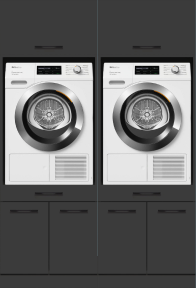
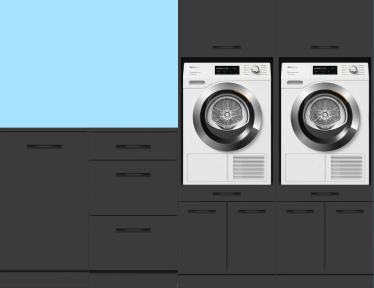
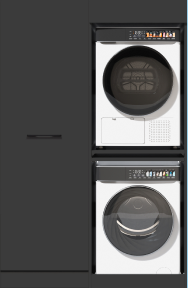
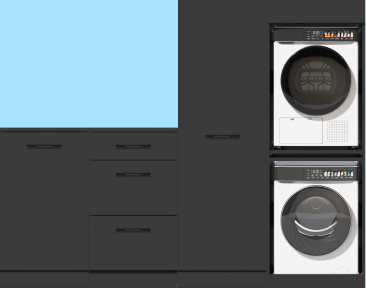
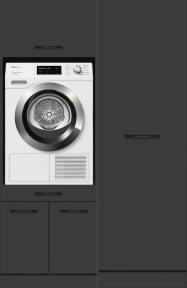
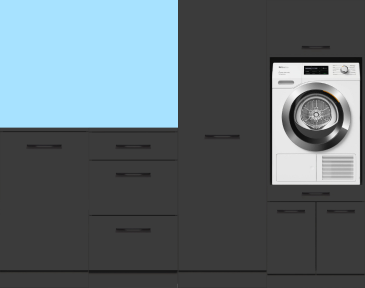
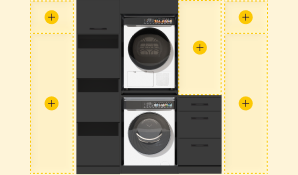
A washing machine cabinet raises the appliance. Immediately check the drain height: if your machine is higher but the drain remains in the same place, the effective lift height increases and the chance of malfunctions rises. Follow the Washing machine in cabinet placement: step-by-step plan for drain and supply for correct routing and drop height. Adjust the drain to 60 to 90 cm and ensure a neat hose passage without kinks. Robust cabinets that dampen vibrations keep the hose stable and reduce loosening of connections. Check all points in advance with the Washing machine cabinet installation checklist: water and drain.
FAQ
How far can a washing machine be from the drain?
As long as the total hose length stays within about 3 to 3.5 meters, the drain is 60 to 90 cm high, and the hose inserts 10 to 20 cm into the pipe, a horizontal distance of 2 to 3 meters is usually feasible. Limit bends and avoid kinks.
What is the maximum length of a washing machine drain hose?
Expect a maximum total length of about 3 to 3.5 meters. The standard hose is often 1.5 to 2 meters; extending it by about 1.5 meters is generally the limit. Use one sturdy coupling and test for leaks.
How far can a washing machine pump?
The pump is designed for a drain height up to about 90 cm. Horizontally, 2 to 3 meters is often fine, provided the height is correct and the hose is free of kinks and excessive bends. If you exceed that, it’s better to relocate the fixed drain.

