

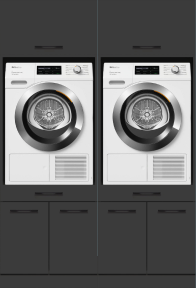
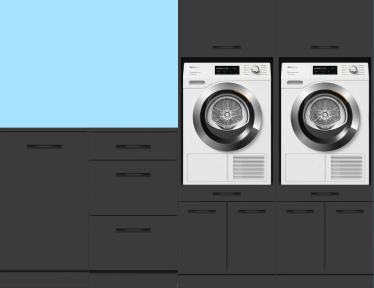
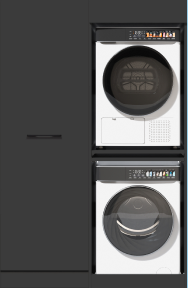
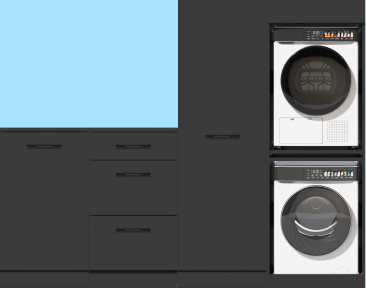
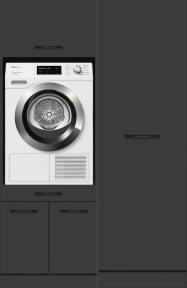
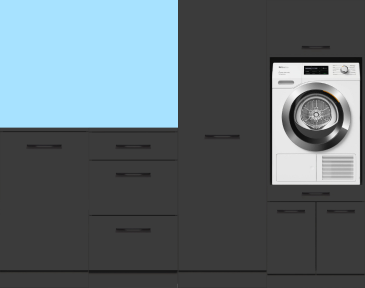
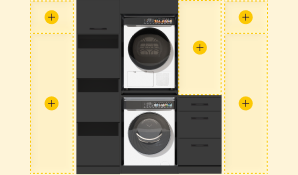

A vibrating washing machine in a cabinet causes noise, can shift, and over time damages the floor and equipment. Good news: with a few targeted checks and adjustments, you can quickly reduce or even prevent most vibrations. Below you’ll read what happens, what you can do immediately, and when a washing machine cabinet really helps.
Why does your washing machine vibrate in a cabinet?
Vibrations mainly occur during spinning. If the drum becomes unbalanced due to unevenly distributed laundry, the machine will move more. In a cabinet, stiff panels and tight spaces amplify the transmission of vibrations and noise, especially with a washing machine in a closed cabinet. The floor also plays a major role: springy floors like wood or laminate flex, increasing vibrations. If the machine or cabinet is not level, even small imbalances are amplified. Finally, worn parts such as shock absorbers or bearings can actually increase vibrations. Always check that transport bolts have been removed after installation.
Solutions in order of impact
Ensure a stable surface
The surface determines how much vibration your washing machine transmits to the cabinet and room. First, make sure the machine is completely level and that all adjustable feet make firm contact with the floor. Consider sturdy washing machine risers to place the machine more stably and at a workable height, provided the floor allows it.
| Surface | Effect on vibrations | What to place underneath? |
|---|---|---|
| Concrete or tile | Rigid, best damping | Thin rubber anti-vibration mat or pads |
| Wood or laminate | Springy, vibrations increase | Rigid board + thin mat, level the machine |
| Floating floor or drip tray | Can resonate or shift | Preferably no thick soft mat, fix and distribute load |
Use vibration dampers and smart placement
Rubber pads or an anti-vibration mat absorb contact vibrations on hard floors. Only use them if the machine is stable and level. On springy floors, thick soft mats often have the opposite effect. Place the machine with a few millimeters of clearance around it, avoiding clamping; see also the required space around the washing machine in the cabinet. A washer-dryer stack can add extra mass if the construction is sturdy and wall anchoring is possible. If needed, reduce the spin speed for large or heavy loads.
When does a washing machine cabinet help?
A good washing machine cabinet mainly helps through mass, rigidity, and decoupling. Thick, stiff panels and smart mounting limit vibration transmission. Adjustable feet and wall anchors ensure everything stands perfectly straight and stable, reducing the chance of imbalance. When buying, pay attention to load capacity, material construction, and build quality, and check the standard built-in dimensions for a washing machine cabinet. At Wasdroom, you’ll find high-quality, TÜV-certified washing machine cabinets with a 10-year warranty and load capacity up to 240 kg (Double) or 120 kg (Single and Stack). We do not offer separate solutions for existing cabinets, but if you are redesigning your laundry space, choose a cabinet that does not amplify vibrations and truly stabilizes the machine. Combine this with a suitable surface and correct placement for the best result. Optionally, follow the step-by-step guide: placing a washing machine in a cabinet for stable installation.
Quick diagnosis checklist
For mounting and alignment points, consult the washing machine cabinet installation checklist.
- Is the machine level and do all adjustable feet touch the floor?
- Have the transport bolts been removed after installation?
- Is the surface rigid enough for your machine and load?
- Is there enough clearance between the machine and cabinet panels?
- Distribute the laundry evenly and reduce spin speed if necessary.
- Do you hear banging or scraping noises? Check shock absorbers and bearings.
Frequently asked questions
How do you recognize broken shock absorbers in a washing machine?
You hear loud bangs or thuds during spinning, the tub swings through or bounces long after. The machine may move noticeably more and “walk away.” Visually, you may see leakage around dampers or loose attachments.
What does a washing machine with broken bearings sound like?
A thudding, scraping, or growling noise that increases with spin speed. When turning the drum manually, you hear a rasping sound and feel play. Often gray metal flakes or leakage traces are visible.
Why does my washing machine move during washing?
Usually due to unbalanced laundry, a springy floor, or an unlevel placement. Worn shock absorbers or loose transport bolts can also be the cause. Redistribute the laundry, level the machine, and check attachments.
What do you put under a washing machine?
On hard floors, rubber pads or a thin anti-vibration mat work well. On springy floors, preferably a rigid board with a thin mat on top. In a drip tray, thick soft mats damp less and increase instability.

