

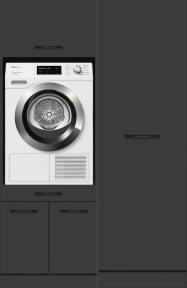
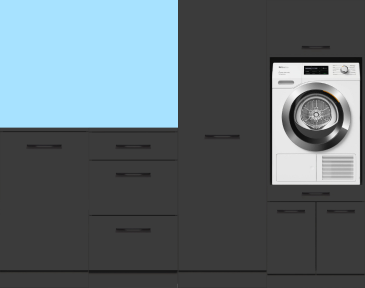
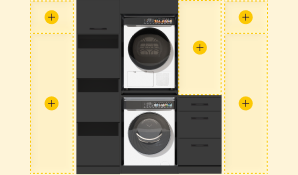

Are you working with a tight niche or shallow laundry space and wondering which cabinet fits a shallow washing machine? The short answer: always calculate extra depth for hoses, plugs, and vibration clearance. A shallow washing machine is often 50-55 cm deep, but including hoses and margin you usually need 65-70 cm internal measurement. Standard washing machines often require 70-75 cm (see also the standard built-in depth of a washing machine). Wasdroom cabinets have a depth of about 70 cm and are designed for stability in real living situations: plug-in mounting, high load capacity, and vibration absorption. Below you will find concrete measurements, measuring steps, and placement tips. Want to be sure per brand if a shallow model fits? Check the dimensions & fit per brand.
Correct cabinet depth per setup
The required cabinet depth depends on the appliance depth, the space behind the machine for hoses, and the clearance at the front. Allow an extra 5-7 cm for hoses and plug if the connections are not recessed in the wall. Leave 2-3 cm free at the front so the door opens smoothly and the drum does not hit the front. Use the guidelines below as a starting point and always measure your own situation. More explanation can be found in how deep should a washing machine cabinet be?.
| Setup | Min. internal depth with shallow washing machine | Min. internal depth with standard washing machine | Extra attention |
|---|---|---|---|
| Solo in cabinet | 65-70 cm | 70-75 cm | Recessing hoses behind or in the wall saves 2-3 cm |
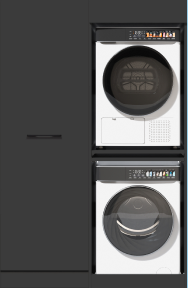
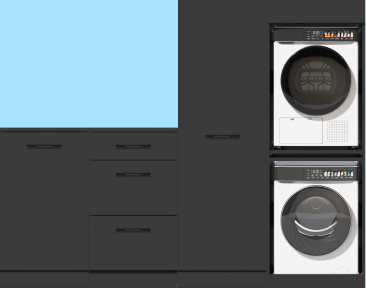
| Stacked with dryer | 70-75 cm | 75+ cm | Stack only with suitable stacking kit and top layer |
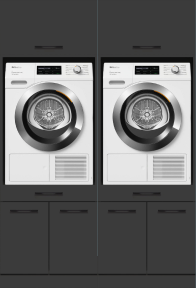
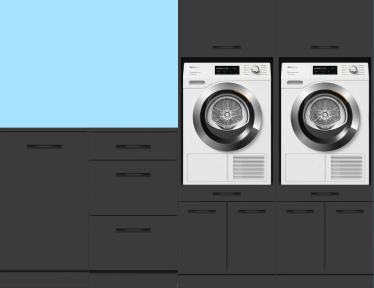
| Side by side in cabinet | 70 cm depth | 70-75 cm depth | Width: 60 cm per appliance + 2-3 cm clearance |
| Shallow niche with built-in taps | 65 cm | 70 cm | Ensure recessed water and power points |
Assumption: appliance depth is measured without protruding hoses or plug. A back wall or baseboard can effectively reduce your internal measurement by 1-2 cm. Read more about the required space behind the washing machine in the cabinet.
How to measure the correct depth
- Measure the actual depth of your washing machine from the back of the tub to the tip of the door handle or edge.
- Check the location of the water tap, drain, and power outlet. Are they recessed in the wall or do they protrude?
- Allow 5-7 cm at your appliance depth for hoses and plug. For recessed connections, 3-5 cm is often enough.
- Reserve 2-3 cm at the front for door clearance and vibrations.
- Measure the net internal dimension of the cabinet from back panel to inside of the front. Include any back panel thickness and door thickness.
- Check the height for vibration clearance above and the width: at least 60 cm per appliance plus 2-3 cm clearance.
- Plan ventilation: an open plinth or grilles at the bottom and top speed up heat dissipation.
Ventilation, safety, and vibrations in a cabinet
Machines generate heat and moisture. Therefore, always provide ventilation openings. An open or perforated plinth draws in cool air, a grille or gap at the top vents warm air. Keep cables and hoses free and avoid kinks. Read here how much space around the washing machine in a cabinet is needed.
Reduce vibrations by leveling the machine and, if necessary, using a damping mat. In tall cabinets, a sturdy base with sufficient load capacity is essential. Wasdroom cabinets are designed for stability and have a load capacity up to 240 kg (Double) or 120 kg (Single and Stack) with vibration-absorbing construction, which in practice reduces panel resonance. Anchor tall cabinets to the wall if needed according to the installation manual.
Combining a shallow washing machine with a dryer or side by side
If you want to stack, check whether your shallow washing machine has a suitable top surface and if a stacking kit is available. Many shallow models do not fit a standard spacer, making stacking impossible. In that case, choose side-by-side placement or a separate cabinet for the dryer. For side-by-side placement: allow 60 cm per appliance plus 2-3 cm clearance per side for cables, vibrations, and ease of installation. In terms of depth, shallow machines often require about 70 cm, standard machines 70-75 cm.
Does a washing machine fit in an IKEA cabinet?
Kitchen cabinets with a depth of 60 cm usually have a net depth smaller than 60 cm due to the back panel and front. A shallow washing machine of 50-55 cm can sometimes fit if water and power points are recessed, the back panel is partially removed, and you leave enough clearance at the front. Pay attention to load capacity, ventilation, and vibration transfer to the cabinet. In practice, a specially designed washing machine cabinet with about 70 cm depth, ventilation provisions, and high load capacity is more reliable and quieter. Wasdroom cabinets are designed for this and offer plug-in installation and stability for daily use. Check out our built-in cabinets for washing machines.
Dimensions of washing machine and dryer
Looking for the cabinet dimensions? Check the dimensions of a washing machine cabinet.
- Shallow washing machine: approx. 50-55 cm deep, 60 cm wide, 84-85 cm high.
- Standard washing machine: approx. 56-65 cm deep, 60 cm wide, 84-85 cm high.
- Heat pump dryer: approx. 60-67 cm deep, 60 cm wide, 84-85 cm high.
- Required extra space at the back: 5-7 cm for hoses and plug, less with recessed connections.
- Front: 2-3 cm clearance for door and vibrations, plus space to load and unload laundry.
Frequently Asked Questions
How deep should a cabinet for a washing machine be?
For a shallow washing machine, an internal dimension of 65-70 cm is usually enough. For standard machines, 70-75 cm is safer. This includes 5-7 cm of rear space for hoses and 2-3 cm clearance at the front. With recessed connections, you can sometimes save 2-3 cm, but always measure your own situation.
What is the shallowest washing machine?
The shallowest models have a tub depth around 50 cm. Note that manufacturers sometimes measure without protruding doors and hoses. Always check the total depth including the door, plus the extra centimeters you need behind for hoses and plug.
Can a washing machine fit in an IKEA cabinet?
It is sometimes possible with a shallow machine, but only if you have enough net depth left, recessed connections, and the cabinet can handle the weight and vibrations. Often, a special washing machine cabinet about 70 cm deep with ventilation and high load capacity is more practical.
How much clearance do you need behind a washing machine in a cabinet?
Allow a standard 5-7 cm for water hose, drain hose, and plug. For recessed water and power points, 3-5 cm may suffice. Make sure hoses do not kink and that the machine can still be moved slightly forward for maintenance.
Can I stack a dryer on a shallow washing machine?
Only if the manufacturer of your shallow model offers a suitable stacking kit and the top layer is suitable. Many shallow washing machines do not support a standard spacer, making stacking impossible. In that case, opt for side-by-side placement or a separate cabinet for the dryer.
Why choose a Wasdroom cabinet for a shallow or standard washing machine
- Depth approximately 70 cm - suitable for shallow and most standard machines.
- Load capacity up to 240 kg (Double) or 120 kg (Single and Stack) and vibration-absorbing design for smoother operation.
- Plug-in installation and 10-year warranty for worry-free setup and use.
Are you unsure about configurations or do you have an exceptional niche? Measure according to the step-by-step plan, check the table, and choose a cabinet with enough margin. This way, you avoid stress during installation and keep the laundry room quiet, safe, and practical.

