

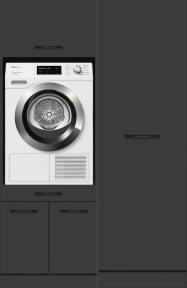
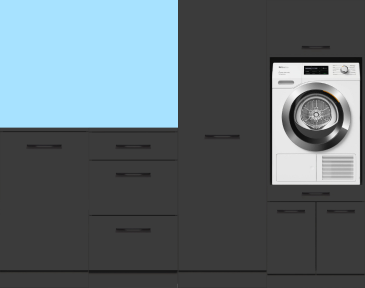

The correct height for your washing machine in a cabinet starts with ergonomics: load and unload without bending, with safe, stable placement. A practical guideline is to have the drum opening at hip height. In most situations, this means a platform height of about 50 to 65 cm, depending on your height and the way the door swings. Also consider space for your laundry basket, door swing, connections, and whether you place the dryer next to or above the washing machine.
Ergonomic guideline: how to determine the right working height
Measure the height of your hip bone and aim to have the drum opening around that point. This minimizes bending and allows you to use the laundry basket nearby and at a comfortable height. For front loaders, a raise with a cabinet or pedestal works best; consider washing machine risers for an ergonomic working height. Pay attention to the door’s pivot point and plan enough clearance so your laundry basket fits on a pull-out platform or shelf. If depth is limited, choose a more compact machine or move your cabinet slightly away from the wall for hoses and plug, provided you properly anchor the structure.
- Height 1.60 - 1.70 m: platform approx. 50 - 55 cm
- Height 1.70 - 1.80 m: platform approx. 55 - 60 cm
- Height 1.80 - 1.90 m: platform approx. 60 - 65 cm
Height advice per setup
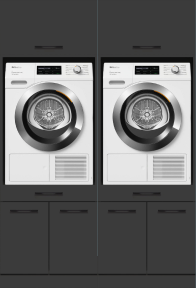
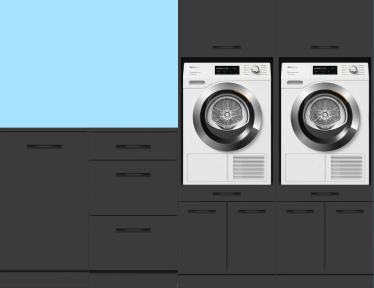
Side by side: washing machine and dryer
Place both appliances on a similar platform height of about 50 - 65 cm for a uniform work surface and optimal ease of use. Provide space for a laundry basket platform or pull-out drawer. Plan the hinge side of the doors smartly so you open the drums towards each other and can transfer laundry in a smooth motion. If you want to raise the placement height, consider a base cabinet or pedestal.
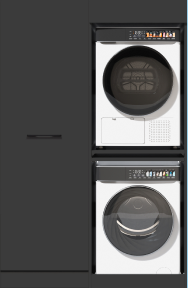
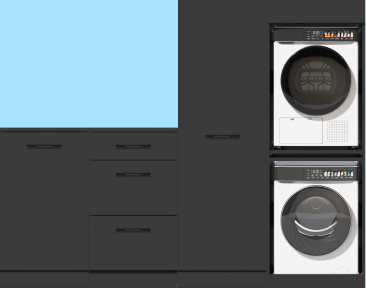
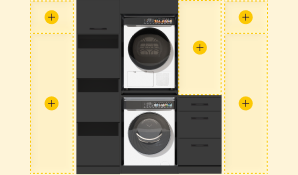
Stacked with dryer on top
Place the washing machine at about 50 - 60 cm and the dryer above it, so the dryer door is around 95 - 110 cm. This allows comfortable opening and closing without reaching. Always use a stacking kit or a cabinet with an intermediate shelf and anchoring. Check door swing, hose lengths, and accessibility of the lint filter and condensate tray beforehand. Are you placing the washing machine on a riser inside the cabinet? Then see Washing machine on a riser in the cabinet.
Top loader
A top loader is usually placed at floor level because of the top lid. If you want to raise it, choose a low pedestal of about 20 - 30 cm and allow extra free height above the appliance for opening the lid. Make sure anchoring and load capacity are explicitly suitable for this setup.
Niche dimensions and ventilation
For a washing machine in a cabinet, space margins are crucial for safety, performance, and air circulation. Always check your appliance’s manual and apply the guidelines below when no specific requirements are given.
| Component | Recommended size |
|---|---|
| Niche width | 63 - 65 cm for most front loaders |
| Niche depth | 65 - 70 cm including hoses and plug |
| Niche height | At least 88 - 90 cm for standard machines |
| Free space behind | 3 - 5 cm for hoses and air |
| Free space above | 2 - 5 cm for heat dissipation |
| Free space on sides | 1 - 2 cm per side |
Want to know more about the required free space above the washing machine in a cabinet? Also check the standard built-in dimensions for a washing machine cabinet for reference sizes.
Stability, water safety, and load capacity
A raised setup requires a stiff, well-anchored cabinet that can withstand weight and centrifugal forces. Check the cabinet’s maximum load capacity and attach it to the wall according to instructions. Level the washing machine’s feet precisely and use anti-vibration mats if needed. Place a drip tray or metal base plate in the niche and keep the drain and tap easily accessible. The stiffer the intermediate shelf and the closer to a load-bearing wall, the less vibration and noise.
Step-by-step plan: measuring and placing at the right height
- Measure your appliances: width, depth, height, door swing, and positions of hoses and plug.
- Determine the working height based on your hip height and choose the matching platform height.
- Check niche dimensions and ventilation space and plan room for a laundry basket platform or drawer.
- Position connections, such as the height of the washing machine tap in a cabinet, and place a drip tray. Test hose lengths and check the correct height of the drain for washing machine in a cabinet beforehand.
- Place the cabinet, anchor firmly, level the machine, and secure against sliding.
- Run a test spin at high speed and check for vibrations, play, and leaks.
Frequently asked questions
What is the ideal height for a washing machine cabinet?
Aim for the user’s hip height. In practice, this usually results in a platform of 50 - 65 cm for a front loader. For a stacked setup, a dryer door around 95 - 110 cm is comfortable. Always adjust to your height, door swing, and space for a laundry basket.
Can you put a washing machine in a cabinet?
Yes, provided the cabinet is designed for the weight and vibrations, and you provide sufficient ventilation, niche dimensions, and accessible connections. Anchor the structure, level the machine, and use a drip tray. Avoid standard wardrobes without reinforcement and ventilation space.
How big should a cabinet be for a washing machine?
For a front loader, allow about 63 - 65 cm niche width, 65 - 70 cm niche depth, and at least 88 - 90 cm niche height. Leave 3 - 5 cm rear space for hoses and 2 - 5 cm top space for heat dissipation. Always check your machine’s specifications for exact margins.
Can you put a washing machine in a Pax cabinet?
That is usually not a good idea. PAX is made for clothing storage, not for heavy, vibrating appliances and generally lacks sufficient ventilation and load capacity. Choose a specific washing machine cabinet or custom solution. Unsure? Ask for advice to ensure safe and stable placement.
Custom advice from Wasdroom
Want to be sure which height and cabinet configuration suits you best? Wasdroom designs washing machine cabinets with attention to ergonomics, ventilation, and stability. Contact us for personal advice and a setup that works perfectly in your space.

