

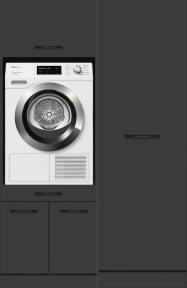
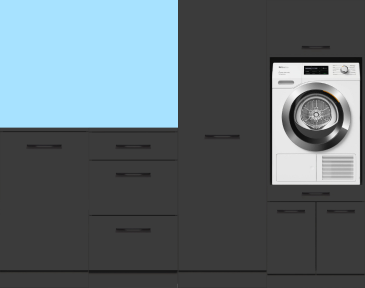
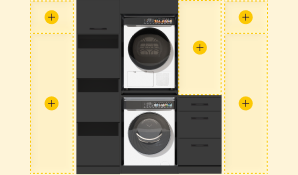

Hiding a washing machine in a kitchen cabinet looks neat and saves space. It is possible in many homes, provided you consider measurements, ventilation, vibrations, and accessibility of the filter flap. This guide gives you a practical step-by-step plan, smart solutions for low filter flaps, and an alternative that offers the same neat look without built-in installation.
Is it allowed to place a regular washing machine in a kitchen cabinet?
Yes, a standard washing machine can be placed in a kitchen cabinet, but there are no true built-in washing machines. You essentially install the machine freestanding behind a front panel. Pay special attention to these points:
- Ventilation – prevent heat buildup and moisture. Ensure enough space around and leave the door slightly open after use.
- Vibrations and noise – use a rigid, flat floor and vibration dampers. Decouple the cabinet structure where necessary.
- Accessibility – the detergent drawer, control panel, and filter flap must remain accessible.
- Water and electricity – grounded wall socket on a dedicated circuit, waterproof connections, and a properly placed drain.
- Rules and permissions – in apartments, permission from the landlord or homeowners association may be required.
Step-by-step plan: hiding the washing machine in a kitchen cabinet
The following approach is suitable for a utility room or kitchen where you want to create a washing machine kitchen cabinet. Work carefully and measure everything. Have connections checked by a professional if in doubt.
- Preparing Provisions
- Ensure water supply, drainage, and a grounded wall socket within 1 meter of the machine. Also, pay attention to the correct height of the washing machine tap.
- Check the floor for flatness and load capacity. If necessary, place vibration dampers or a heavy, rigid base plate.
- Determining Measurements
- Reserve at least 60 cm width and 60-65 cm depth, plus extra space for hoses and plug. See also the standard dimensions for a washing machine cabinet.
- Allow 2-3 cm clearance on the left, right, and back for ventilation and maneuvering.
- Choosing the Cabinet Layout
- Use two side panels or cabinets next to the machine for stability.
- Use a front panel and a door front to visually hide the washing machine in the kitchen cabinet.
- Creating a Stable Base
- Place the machine on a flat, rigid surface and adjust the feet precisely level.
- Do not attach a rigid connection between the machine and cabinet – allow the machine to move freely to reduce resonance.
- Mount front and door
- Install the front panel aligned with adjacent cabinets and adjust the door hinges so the door can open freely.
- Check that the control panel and detergent drawer are fully accessible.
- Connecting and testing
- Connect water and drainage leak-free and check for kinks in hoses.
- Run a test wash with the cabinet door open. Watch for vibrations and leaks. Adjust as needed.
- Ensure ventilation
- After each wash, leave the door slightly ajar for a short time and dry edges and seals.
- Consider discreet ventilation mesh in the plinth if the space gets warm or smells musty.
Access to low filter hatch – removable plinth
On many machines, the filter hatch is low at the front. With a fixed plinth, you can’t reach it. Here’s how to make a neat, removable solution that’s easy to operate:
- Measure and plan
- Determine the height and depth of the plinth and mark where the filter hatch is located.
- Allow at least 10-15 mm clearance between the plinth and the appliance to avoid resonance.
- Choose a fastening method
- Magnetic closures or plinth clips – quick to remove, invisible from the outside.
- Sliding plinth on guides – plinth slides out or down without full disassembly.
- High-adhesion Velcro – handy in limited space, easy to remove.
- Create a service hatch in the plinth
- Saw a narrow notch or flap at the height of the filter hatch if the plinth is high.
- Finish the edges neatly and use a small handle strip or recessed handle for operation.
- Install water barrier and protection
- Apply a rubber sealing profile or threshold profile at the bottom of the plinth as a splash guard.
- Place a drip cloth or drip tray ready for opening the filter to prevent damage from residual water.
- Finishing and ventilation
- Provide small ventilation openings at the back or in the plinth if the niche feels warm.
- Check that the plinth does not press against the appliance – prevention is better than rattling noise.
- Practical use
- Unclip the plinth, clean the filter, and reattach the plinth. Test that everything is secure and free of play.
- Perform this maintenance regularly to prevent malfunctions and error codes.
Alternative to built-in: freestanding washing machine cabinet
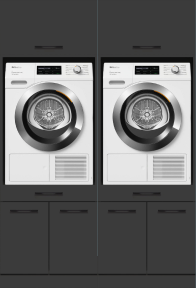
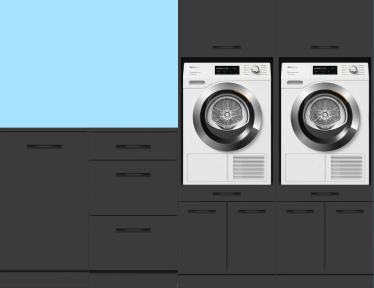
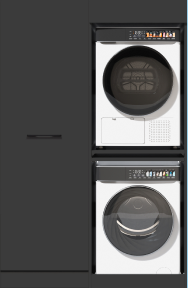
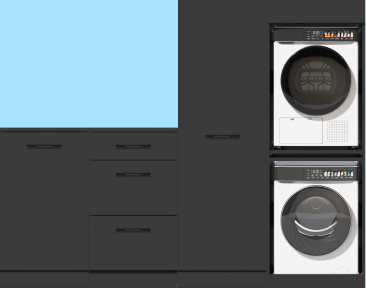
Do you want the look of a kitchen cabinet for your washing machine and dryer, but without sawing, drilling, and the risk of resonance? Wasdroom offers freestanding washing machine cabinets that provide a sleek, kitchen cabinet appearance without built-in installation. Advantages:
- No renovation – plug-in installation and suitable for rental homes.
- Vibration-absorbing and robust – load capacity up to 240 kg (Double) or 120 kg (Single and Stack) per cabinet.
- Smart layout – soft-close doors and drawers for detergents.
- Choice for every situation:
- Single Series – 1 appliance with storage space.
- Double Series – washing machine and dryer side by side with worktop.
- Stacked Series – stacked for narrow spaces.
- 10 years warranty and support.
This is how you get the neat look of a kitchen cabinet for your washing machine without compromising ventilation or accessibility.
Dimensions and connections – what do you minimally need?
Guideline dimensions for a washing machine in a kitchen cabinet:
- Width 60 cm, depth 60-65 cm, height 82-85 cm free niche. Reserve extra space for hoses and plug.
- 2-3 cm clearance around for ventilation and placement.
- Flat, rigid floor – level the feet and use dampers if needed.
- Water supply and drainage within 1 meter, leak-free and securely fastened.
- Grounded wall socket on its own circuit, cord free from pinch points.
Use and maintenance after installation
- Leave the door ajar for 15-30 minutes after each wash for dryness and fresh air.
- Clean the filter every 1-3 months via your removable plinth solution.
- Check hoses annually for wear and replace if cracked or corroded.
- Use liquid detergent or a measuring cup if the soap drawer is hard to reach.
- Do you hear resonance? Level the machine, adjust the feet, and check clearance with the cabinet.
Frequently Asked Questions
Can a washing machine fit in a kitchen cabinet?
Yes, it can, but you are visually integrating a freestanding machine behind a front panel. Ensure sufficient ventilation, a rigid floor, vibration dampers, and a removable plinth for the filter. Always test a full wash cycle before finishing the cabinet permanently.
Can a washing machine be placed in an IKEA kitchen cabinet?
Installing a washing machine in an IKEA kitchen cabinet is technically possible, but kitchen cabinets are not designed for dynamic loads. Reinforce where necessary, allow clearance, and check warranty conditions for both cabinet and appliance. Consider a freestanding washing machine cabinet if you want to avoid resonance or warranty issues.
Should the kitchen door be open during spinning?
No, if there is sufficient ventilation, you do not need it. If it gets warm or smells musty, leave the door slightly open during and after washing. Never use a doorstop that restricts the machine – the machine must be able to move freely.
Do I need permission from the landlord or homeowners' association?
Often yes. You may change connections, vibration levels, and cabinet layout. Check the house rules or rental contract and ask for permission in advance. In rental homes, a freestanding kitchen cabinet washing machine solution is usually easy to install.

