

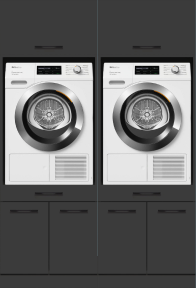
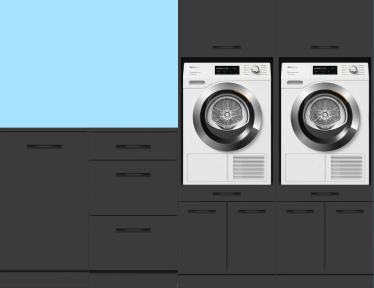
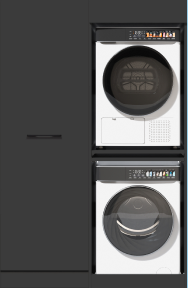
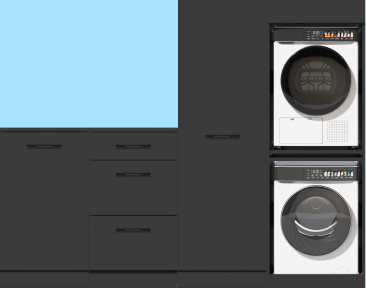
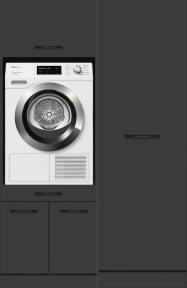
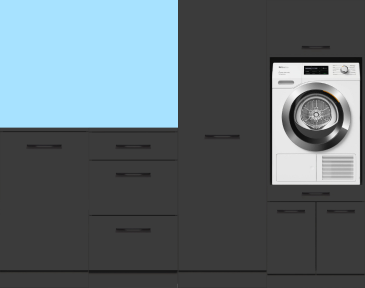
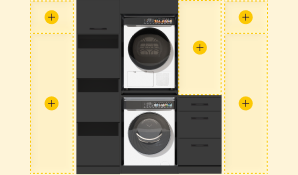
A washing machine cabinet saves space and looks sleek, but small installation or selection mistakes can quickly cause extra vibrations, noise, or even damage. With the tips below, you can avoid the most common errors and set up your laundry area safely, quietly, and sustainably.
Contact noise vs. airborne noise: address the right problem
Not every annoying sound requires the same solution. Contact noise occurs when the machine and cabinet transmit vibrations to the floor, walls, or ceiling. The solution is to decouple and add mass: ensure a stable, flat base and prevent direct contact between appliances and the structure. Airborne noise is the audible sound leaking through the air from the cabinet. You reduce this with absorbing materials and by limiting gaps.
Practically, this means: level the washing machine, use decoupling pads or a compact vibration mat under the feet, and make sure the cabinet is not pressed tightly against the wall. If desired, finish the inside with solid, dense panels and narrow, air-permeable gaps. You cannot make a washing machine cabinet completely soundproof—focus on dampening rather than sealing. More tips: Leveling and stabilizing your washing machine.
Start with the basics: floor, leveling, and decoupling
The subfloor determines how much energy the machine can dissipate without “walking.” It’s easier on concrete than on wooden or floating floors. Always check the flatness and stiffness of the floor. If the machine is on a wooden floor, reinforce a platform or joist and distribute the load over multiple support points.
Precisely level the feet of both the machine and the cabinet. Adjustable feet—like those on Wasdroom cabinets—correct unevenness, reducing the chance of vibrations. Decouple the machine from the floor with compact, sturdy vibration dampers under the feet. Avoid thick, soft rubber mats that act like springs, as they can sometimes increase shaking.
Pay attention to load capacity and anchoring: a full washing machine and dryer together can easily weigh over 150 kg. Wasdroom cabinets are TÜV-certified and suitable for up to 240 kg (Double) or 120 kg (Single and Stack) per cabinet, with a special anti-tip lock to prevent the cabinet from vibrating out. Anchor according to the manual to a load-bearing wall and check the fixation again during spinning. Forgot anything? Use the Washing machine cabinet installation checklist.
Building the washing machine cabinet to reduce resonance
A stiff, well-assembled cabinet resonates less. Tighten connections firmly and, where possible, install a continuous back panel to limit torsion. Avoid hard contact bridges: do not press the cabinet tightly against the ceiling or walls, and use thin decoupling strips between the cabinet and wall if needed.
Ensure appliances do not rub against wood or metal profiles anywhere. Maintain sufficient clearance around according to the manufacturer’s instructions and place anti-slip pads on shelves or support plates. Pull-out trays require solid rails with correct load capacity—no play or crooked installation. Wasdroom’s construction is designed to absorb vibrations; follow the assembly sequence in the manual for the best result. Unsure about minimum clearance and dimensions? See the Dimensions of a washing machine cabinet.
Ventilation and safety often overlooked
Heat and moisture quickly build up in a closed cabinet. Provide sufficient supply and exhaust air, for example through vents in the bottom or back panel. Read more about proper ventilation in a washing machine cabinet. Keep a few centimeters of free space around the machine—exactly as the manufacturer prescribes—so the motor and electronics stay cool.
Secure the installation: anchor the cabinet to prevent tipping, use a drip tray or water trap where there is a risk of leakage, and choose sturdy wall anchors. Check that the electrical system is grounded and that cords and hoses do not kink when the machine vibrates. Also verify the correct washing machine drain height in the cabinet to prevent malfunctions and leaks. Preferably place a dryer on top using an official stacking kit or use a double washing machine cabinet designed for that purpose. Also read about electrical setup for a washing machine cabinet: outlets and circuits.
Top 9 common mistakes that cause more noise and damage
- Not leveling properly – Uneven feet cause swaying and erratic movement.
- Too soft damping mat – A thick, springy mat increases shaking.
- Cabinet touches wall or ceiling – Hard contact bridges transmit vibrations.
- No anchoring – The cabinet can shift or tip at high speeds.
- Insufficient ventilation – Heat and moisture increase wear and noise.
- Weak floor or platform – Sagging amplifies resonance.
- Hard contact points inside the cabinet – Appliance knocks against shelves or profiles.
- Incorrect stacking – Without stacking kit or tilt lock, extra risk arises.
- Overloaded drum – Imbalance and extreme vibrations during spinning.
Frequently Asked Questions
Why does my washing machine vibrate inside the cabinet?
Usually, the cause is contact noise due to an unstable base or incorrect installation. Check in order: is the machine level, are the transport bolts removed, is the floor stiff enough, and does the cabinet avoid contact with walls or ceiling? Place compact vibration dampers under the feet and anchor the cabinet. If the problem persists, reduce the spin speed or select a different wash program and check the load for imbalance.
How can I reinforce my washing machine inside a cabinet?
Limit clearance and stiffen the structure: use a continuous back panel, tighten all connections, anchor the cabinet to a load-bearing wall, and distribute the weight via adjustable feet. Decouple contact points with thin damping strips and place the machine on sturdy pads. Preferably choose a cabinet with high load capacity and a tilt lock, such as the TÜV-certified models from Wasdroom.
Want to be sure you choose the right cabinet and installation for your situation? The specialists at Wasdroom are happy to help with sizing, load capacity, and placement so you can wash quietly, safely, and worry-free.
Leave a comment
This site is protected by hCaptcha and the hCaptcha Privacy Policy and Terms of Service apply.