

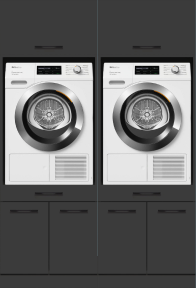
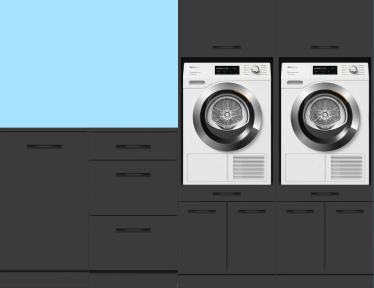
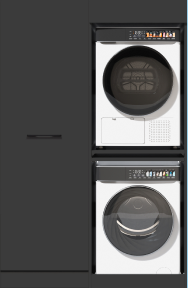
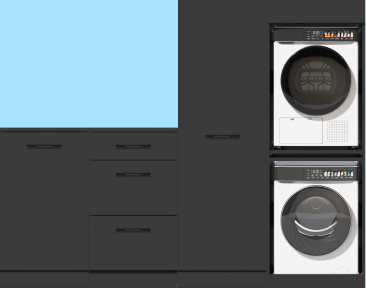
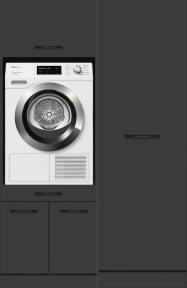
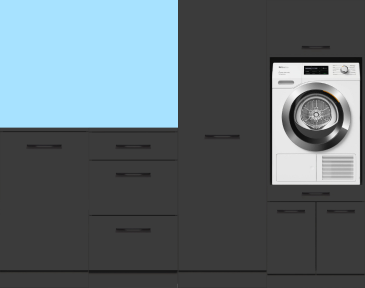
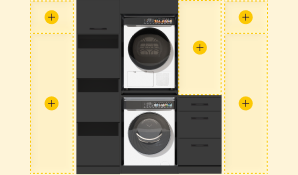
Neatly concealing pipes and drainage in your washing machine cabinet starts with the right routing, sufficient clearance, and good accessibility. This prevents leaks, blockages, and vibration transmission. Wasdroom cabinets come standard with 8 cm of space behind the machine for hoses and drainage. If you need more, you can position the cabinet slightly away from the wall using a bracket. This guide provides practical routes without unnecessary demolition, the correct dimensions, and installation requirements for a reliable, quiet setup.
Smart routes for drainage and water pipes without demolition
If you want to hide the drainage and pipes invisibly without chiseling into load-bearing walls, choose one of these proven routes. They combine aesthetics with ease of maintenance and meet the requirements for sufficient slope and bending radius. Also plan the supply and drainage points at the correct height; see connecting a washing machine in a cabinet for practical steps.
- In a duct along the wall: build a slim duct of plasterboard on wooden battens. Allow at least 6 cm thickness and about 15 cm width for a 50 mm drainage pipe with insulation and fastening.
- Via stair cupboard or stairwell: let the drainage pipe descend to an existing soil stack or connection lower in the house. Ensure smooth bends and service openings at tight spots.
- To the crawl space: straight down behind the cabinet in a duct, then horizontally with sufficient slope to the main drain. Useful for wooden floors or available penetrations.
- Furring wall: install a shallow furring wall behind the cabinet. You gain space for pipes and keep everything accessible via a removable panel.
Space and clearance around the washing machine in the cabinet
Sufficient clearance prevents vibrations, kinks in hoses, and malfunctions. In a Wasdroom cabinet, 8 cm is reserved behind the machine for drainage and pipes. If necessary, use a bracket to create extra distance from the wall and maintain wide bends for the drain hose. Read more about the required space behind the washing machine in the cabinet.
| Location | Recommended clearance |
|---|---|
| Back | 8 - 10 cm for drainage, tap, and cables |
| Sides | 1 - 2 cm per side for vibration-free movement |
| Top | 2 - 3 cm to prevent resonance |
| Front | At least 5 cm for vibrations and operation |
| Service opening | About 10 x 10 cm at couplings or siphon |
Choose a tap position that remains accessible and out of sight; guidelines and dimensions can be found at the height of the washing machine tap in a cabinet.
Requirements for drainage and installation
For trouble-free drainage of washing water, a few strict requirements apply. Check these points before permanently placing the cabinet.
- Washing machine drain pipe: minimum 50 mm diameter for sufficient flow.
- Soil stack with siphon: top edge about 60 - 90 cm above the floor, prevents backflow and odors.
- Slope of horizontal pipe: 1 - 2 cm per meter towards the main drain.
- Drain hose: secure with a bracket in the soil stack, allow a wide bend without kinks.
If you doubt the position and height of the soil stack or hose, consult the drainage height for a washing machine in a cabinet for exact guidelines. Want to connect a washing machine and dryer to one drain? Then read how to do this safely at washing machine and dryer on the same drain.
Electricity and accessibility
Do not place the outlet directly behind the machine but slightly to the side or higher in the cabinet, so the plug and cable can move freely and remain accessible. For a washing machine, a dedicated circuit with residual current device is common. T-splitting or branching in the cabinet is not recommended. Provide service openings at taps, couplings, and siphon so you can quickly fix leaks without demolition. Also check the full requirements for electricity and water in a washing machine cabinet.
Structurally responsible concealment
Horizontal chiseling in load-bearing walls or hollow core slabs weakens the structure and is not recommended. Also, screed floors often lack sufficient slope for reliable drainage. Therefore, choose a duct, furring wall, or the existing shaft. Use vibration-damping materials and sturdy brackets to fix the drain pipe. Mount the cabinet firmly to the wall and ensure the whole is level – Wasdroom cabinets absorb vibrations and support up to 240 kg (Double) or 120 kg (Single and Stack), but the base and fastening determine the final result.
Frequently Asked Questions
How can I hide the drainage of my washing machine?
Conceal the drain pipe in a duct or furring wall behind the washing machine cabinet. Leave a service opening at the siphon and ensure 8 - 10 cm of space behind the machine for hoses and couplings.
Can you remove the drain pipe of a washing machine?
Only if you install a new route with a 50 mm pipe, siphon, and sufficient slope. Always connect to a suitable soil stack and check for accessible couplings for maintenance.
What is the maximum distance between the washing machine and the drain?
Keep horizontal runs as short as possible with 1 - 2 cm slope per meter. Long flat sections increase the risk of blockage – in that case, choose a route via a shaft or crawl space. See also the maximum distance from washing machine to drain.
Can I close off the drain pipe of a washing machine?
Use a closing cap or plug only on unused branches. The active drain must always be open, ventilated, and equipped with a siphon to prevent backflow and odors.
Leave a comment
This site is protected by hCaptcha and the hCaptcha Privacy Policy and Terms of Service apply.