


The correct depth of your washing machine cabinet prevents vibrations, noise, and damaged hoses. Don’t just consider the appliance size on paper, but also account for plugs, drain hoses, and ventilation. Below you’ll find practical guidelines per setup, a measurement step plan, and key points for a safe, quiet, and durable installation. Want to first organize your laundry space smartly and estimate the required cabinet depth? Then read: Organizing Your Laundry Space: Guidelines for Depth.
Recommended Depths per Setup
Washing machines are usually 56-64 cm deep, dryers 58-66 cm. Add 5-8 cm for hoses and plugs, plus a small ventilation space. Use the table below as a starting point and always measure your own situation.
| Setup | Typical Appliance Depth | Extra Space Behind | Recommended Internal Cabinet Depth |
|---|---|---|---|
| Single appliance (washing machine or dryer) | 56-66 cm | 5-8 cm | 66-74 cm |
| Washing machine and dryer side by side | Take the deeper of the two | 5-8 cm | 70-75 cm |
| Stacked with stacking kit | Deepest appliance + 1-2 cm | 5-8 cm | 72-78 cm |
Choose the matching cabinet series per setup:
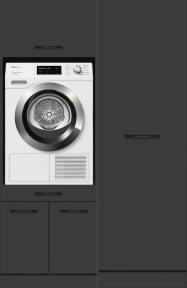
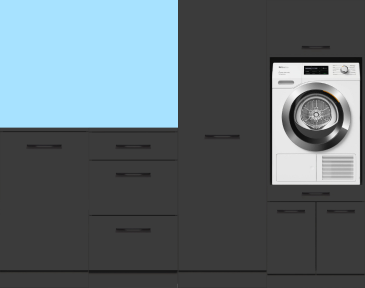
- Single appliance: Single Series — standard depths for a single washing machine or dryer cabinet.
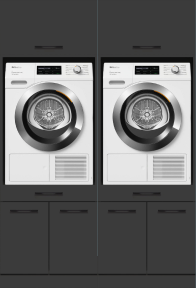
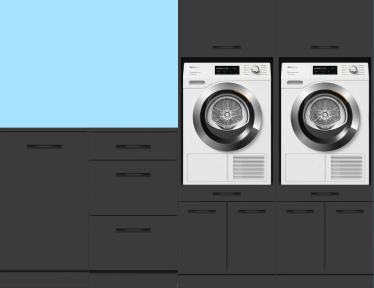
- Side by side: Double Series — depth and sizing for a double setup.
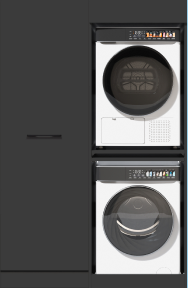
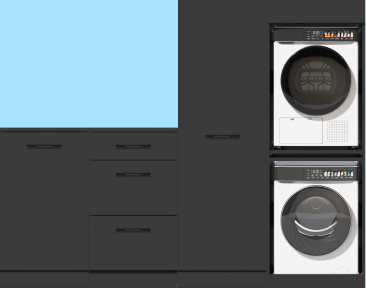
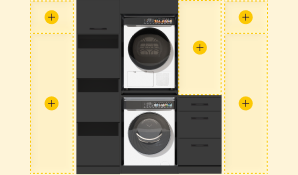
- Stacked: Stack Series — depth tips and options for a stacked setup.
Allow 2-3 cm clearance at the front for the door and seals. Preferably place outlets and taps not directly behind the middle of the machine, but to the side or higher to save depth.
How to Determine the Correct Depth
- Measure the appliance – Measure the actual depth including door and any protruding knobs.
- Include protrusions – Add 5-8 cm for plug, drain, and water supply unless these are placed sideways or higher.
- Reserve ventilation space – Keep 2-3 cm free at the back or side, especially for heat pump dryers.
- Check the floor and baseboard – A baseboard or threshold can effectively reduce the built-in depth.
- Plan the door opening – Ensure the machine can move 2-3 cm forward without blocking the cabinet doors.
- Stacking kit or shelf – Add 1-2 cm if you use a stacking kit or pull-out shelf.
- Test with a template – Use cardboard cut to size to see if hoses and plug fit freely inside the cabinet.
- Verify your choice – Check the correct depth with the configurator and see immediately if your setup fits.
Ventilation, Safety, and Vibrations
Good ventilation extends the lifespan of your equipment and prevents mold growth. Therefore, provide an open baseboard or ventilation grilles, and avoid a fully closed back. Always secure a stacked setup with a stacking kit and use a wall anchor or anti-tip device when stacking high. Place machines level and use vibration dampers if your floor flexes or the cabinet is on an upper floor. Wasdroom cabinets are made from high-quality melamine-coated fiberboard, designed to absorb vibrations, TÜV-certified, and load-bearing up to 240 kg (Double) or 120 kg (Single and Stack). Combine this with proper clearance behind the appliances for a quiet, safe setup. For exact dimensions and installation guidelines: Dimensions and Assembly Instructions.
Frequently Asked Questions
How deep should a cabinet for a washing machine be?
Aim for 66-74 cm internal depth. Most washing machines are 56-64 cm deep, plus 5-8 cm for hoses and plug, and 2-3 cm for movement at the front. Preferably place connections high or sideways to save depth.
How much space do you need for a washing machine and dryer?
Side by side: 70-75 cm internal depth and enough width for both appliances plus 1-2 cm clearance per side. Stacked: 72-78 cm internal depth and a stacking kit, plus a wall anchor or anti-tip device for safety and stability.
How deep is a washing machine cabinet?
That varies by brand and model. Practically, 70-75 cm internal depth works in most situations, but measure your own appliances and connection points. If you have a shallow niche, expect the door or front to protrude a few centimeters.
What is the depth of a washing machine and a dryer?
Washing machines: often 56-64 cm. Dryers: 58-66 cm, heat pump dryers sometimes a bit deeper due to construction. Always check product specifications and measure the actual appliance including door and knobs.
Are you working with Wasdroom’s Double, Single, or Stack Series? The materials are designed for vibration damping, installation is plug-and-play, and you get a 10-year warranty. Because depth can vary per setup, we recommend measuring your appliances and connection points and contacting our customer service for tailored advice if in doubt.

