


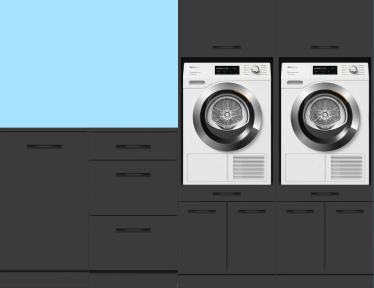
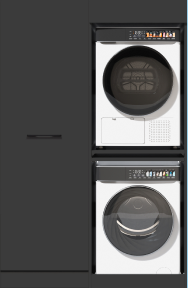
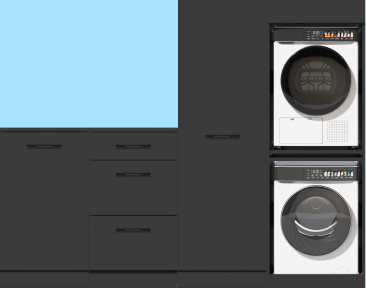
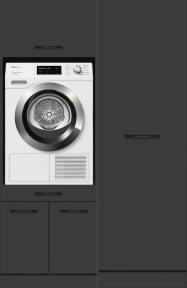



A washing machine cabinet must handle more than just the stationary weight of your device. During spinning, vibrations, peak loads, and lateral forces occur that are much heavier than the number of kilos on the type plate suggests. That is precisely why the load capacity and mounting of washing machine cabinets are crucial for safety, stability, and longevity. If you choose a cabinet not designed for this, you risk sagging, loose connections, extra noise, and unsafe situations. In this article, you will read what to practically watch for if you want to place a washing machine in a cabinet, stack it, or want to know if a standard cabinet construction is strong enough.
Why load capacity in a washing machine cabinet is more than just the weight of the machine
Many people first look at the net weight of the washing machine or dryer. That makes sense, but for a safe setup, the total load during use is especially important. A washing machine moves during spinning. This means the cabinet not only has to handle vertical pressure but also vibrations and dynamic forces. Especially with an imbalance in the drum, this load can increase significantly.
That is why a load capacity only really means something if the cabinet is also designed for stability, connections, base strength, and proper mounting. A cabinet that can carry many kilos on paper but is not firmly attached to the wall or lacks sufficient torsional stiffness can still cause problems. For washing machine cabinets, it’s about the combination of material quality, construction, load distribution, and installation.
How much load capacity should a washing machine cabinet have?
The right load capacity depends on your setup. For a single machine, the device's own weight is just the starting point. You always want to leave a margin for vibrations, water content, and prolonged load. For a cabinet with a washing machine and dryer side by side or stacked, these requirements increase further.
At Wasdroom, for example, there are models for different loads, such as a single model with a load capacity of 120 kg, but also heavier versions up to 240 kg per setup. This immediately shows that not every cabinet is suitable for every situation. The heavier the equipment and the more intensive the use, the more important a higher safety margin becomes.
| Setup | What to watch for | Required safety margin |
|---|---|---|
| Single washing machine | Device weight, vibrations, base strength | Ample margin above empty weight |
| Washing machine and dryer side by side | Total load, distribution over the cabinet, torsional stiffness | Higher due to combined load |
| Stacked setup | Point load, stability, wall mounting, stacking kit | Very important due to height and center of gravity |
Which components determine if a washing machine cabinet is truly sturdy?
A good washing machine cabinet is recognized not by a single specification but by the overall construction. The base must be able to support the load over time without bending. The side panels and joints must absorb lateral forces. Adjustable anti-vibration feet help level the setup and better absorb vibrations. A sturdy melamine finish or other moisture-resistant surface is also important in a space where condensation and splashes can occur.
Additionally, the attachment makes a big difference. A cabinet that stands freely is more likely to shift or move during use. A model with good wall mounting and a tilt lock is therefore safer, especially for taller setups. Wasdroom highlights features such as adjustable anti-vibration feet, a special anti-tip lock, and TÜV certification as contributing to stability and safety. The choice of material for a vibration-resistant washing machine cabinet also plays an important role.
Important construction features
- Sturdy base plate that can handle point loads
- Stable side panels and solid joints
- Moisture-resistant material or coating
- Adjustable feet for leveling
- Anti-vibration setup to reduce resonance
- Safe wall mounting and tilt lock
Why wall attachment is so important
When it comes to securing washing machine cabinets, wall mounting is often underestimated. Yet, it is one of the most important conditions for a safe setup. A washing machine cabinet experiences not only downward pressure but also pulling and lateral forces. During spinning, these forces can cause the cabinet to move, especially if the floor is not perfectly level or if the machine is not exactly balanced.
By firmly attaching the cabinet to the wall, you reduce the risk of tipping, shifting, and extra stress on the joints. This is even more important with a stacked setup or when placing a dryer and washing machine on top of each other in a cabinet. The higher the center of gravity, the more crucial a secure attachment becomes. For those who want to approach this step by step, more information can be found about attaching a washing machine cabinet to the wall. A tilt lock or wall bracket is not just an extra, but an essential part of the construction.
Always check if the wall is suitable for the chosen fastening. A solid, massive wall requires something different than a lighter partition wall. The right plugs, screws, and mounting points are just as important as the cabinet itself. Also, correctly adjusting and fastening a washing machine cabinet helps prevent problems in the long term.
Placing a washing machine in a cabinet - where does it often go wrong in practice?
Most problems do not arise because a cabinet collapses immediately, but because multiple small errors together cause instability. Think of a floor that is not completely level, a machine placed too close to side panels, a weak rear construction, or missing wall mounting. It is also often forgotten that a cabinet must have enough space for hoses, plugs, and ventilation. Unsure about the floor? Read more about the best floor under a washing machine.
Another common mistake is using a standard furniture cabinet as if it were a washing machine cabinet. A regular storage cabinet, wardrobe, or Ikea cabinet is usually not designed for dynamic loads, moisture, and vibrations. As a result, the construction may seem sturdy on paper but is insufficient in use. If you want to install a washing machine in a cabinet, always choose a solution specifically designed for white goods load.
Can I put a washing machine on an Ikea cabinet?
In practice, this is usually not a good idea. A standard Ikea cabinet or other furniture cabinet is generally made for static loads: items that remain still. A washing machine causes vibrations, shocks, and varying forces. Ordinary furniture panels, joints, and bases are usually not designed for this.
Even if the machine's weight seems to be within the cabinet's maximum load capacity, that does not guarantee safety during spinning. The wall mounting, furniture stiffness, and base stability also play a role. For white goods, you therefore need a specially designed washing machine cabinet, not just a standard cabinet construction.
Safe stacking - load capacity and fastening in a tall setup
If you want to stack a dryer and washing machine in a cabinet, load capacity and fastening become even more important. In a stacked setup, the point load increases and the center of gravity is higher. This makes the cabinet more sensitive to movement and the construction must be extra stable.
The basic rule remains that the washing machine is at the bottom and the dryer on top. The washing machine is heavier and causes most vibrations. An official stacking kit or suitable spacer is needed to prevent shifting and distribute the load correctly. Additionally, the cabinet itself must be suitable for this configuration, including sturdy wall mounting and enough space for ventilation and maintenance.
Checkpoints when stacking in a cabinet
- Washing machine always below, dryer above
- Use a suitable stacking kit or spacer
- Check if the cabinet is designed for stacking
- Ensure wall mounting and tilt protection
- Allow enough space for ventilation and connections
- Check if the floor can handle the load
What exactly does an anti-vibration solution do?
Anti-vibration is not a replacement for load capacity but a supplement to it. Adjustable anti-vibration feet or vibration-damping solutions help limit resonance between the machine, cabinet, and floor. This reduces the chance of sliding, rattling, and extra noise. It also keeps the load more evenly distributed.
This is especially important when you want to lift the washing machine into a cabinet or place it at an elevated height. The stiffer and more stable the setup, the better vibrations are controlled. But beware: if the machine is not level or the cabinet is mounted incorrectly, anti-vibration feet will not solve that basic problem. They only work well if the entire construction is correct. If you notice a lot of movement or noise despite a sturdy setup, check how to prevent vibrations and noise in a washing machine cabinet.
Practical checklist for load capacity and mounting of washing machine cabinets
- Check the weight of your washing machine and dryer
- Choose a cabinet with sufficient load capacity and safety margin
- Do not use a standard furniture cabinet for appliances
- Make sure the cabinet is completely level
- Securely attach the cabinet to a suitable wall
- Use anti-vibration feet or a suitable vibration-damping solution
- Leave space for hoses, plug, and ventilation
- Always use a stacking kit when stacking
- After installation, check that the machine does not touch the cabinet anywhere
- Run a test program and pay attention to movement, noise, and stability
Frequently asked questions about load capacity and mounting of washing machine cabinets
Can I install a washing machine inside a cabinet?
Yes, but only if the cabinet is suitable for the weight, vibrations, and ventilation of a washing machine. A regular cabinet is usually not strong or stable enough. Therefore, choose a proper washing machine cabinet with sufficient load capacity, good mounting, and space for connections.
How can I lift my washing machine into the cabinet?
Preferably do this with two people and never alone. Lift carefully, use a good grip, and avoid placing the machine crookedly on the base plate. For elevated setups, it is smart to clear the route beforehand and ensure the cabinet is fully level and securely mounted first. After that, it is important to place your washing machine stably in the cabinet so the load remains well distributed.
Can I place a dryer and washing machine on top of each other in a cabinet?
Yes, provided the cabinet is designed for this and you use a suitable stacking kit. The washing machine goes at the bottom, the dryer on top. Additionally, wall mounting, stability, and sufficient load capacity are essential for safe stacking.
Is a high load capacity alone enough?
No. A high load capacity is important but does not tell the whole story. The stiffness of the construction, the quality of the mounting, the flatness of the floor, and vibration control also determine whether a setup is truly safe.
Why is wall mounting necessary if the cabinet is already heavy?
Because a heavy cabinet can still move or tip over under dynamic loads. Especially during spinning, forces arise that do not only act downward. Wall mounting helps keep the cabinet in place and significantly increases safety.
How do I know if my floor is strong enough?
Besides the cabinet itself, the floor must also be able to support the total load. When in doubt, for example on wooden floors or older upper floors, it is wise to have the floor’s load capacity assessed. This prevents problems later, especially with stacked or heavy setups. In such cases, it is also smart to look into floor reinforcement for a washing machine cabinet.
Can a washing machine be placed on top of a dryer?
That is not recommended. The washing machine is usually heavier and causes the most movement. For stability, the washing machine should be placed at the bottom and the dryer on top.
What to consider when choosing a washing machine cabinet
Don't just compare appearance or size, but focus on technical suitability. Look at the specified load capacity, the method of mounting, the presence of anti-vibration solutions, and whether the cabinet has been tested or certified. Practical aspects such as adjustable feet, space for connections, and suitability for single or double setups also make a difference.
For those seeking certainty, it is wise to choose a cabinet explicitly designed for white goods, where load capacity, vibration control, and mounting are all integrated. It is precisely this combination that determines whether your washing machine cabinet will remain quiet, safe, and stable in the long term.

