

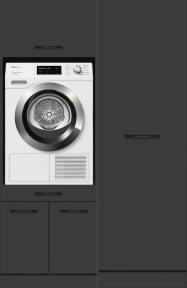
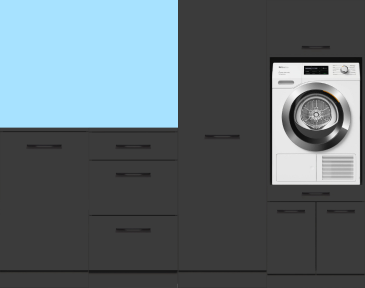
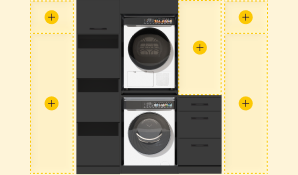

A washing machine cabinet endures a lot: weight, moisture, vibrations, and daily use. The right material choice determines whether your cabinet remains quiet, safe, and durable. Pay special attention to stiffness, moisture resistance, load capacity, and edge finishing. On this page, you can compare particleboard, MDF, and plywood, discover which solutions to apply under the washing machine, and get practical tips to reduce vibrations and correctly position your cabinet. If you want to dive deeper into the impact of material choice on vibrations, check out Vibration-Resistant Material for Washing Machine Cabinets.
Particleboard, MDF, or Plywood – What Should You Choose?
Decorative particleboard is a commonly used choice for washing machine cabinets. The material consists of wood chips with resin, often finished with melamine or HPL for a wear-resistant, moisture-proof top layer. Advantages: affordable price, wide range of decor options, and good dimensional stability. Points to consider: properly seal the cut edges and handle screw connections carefully when repeatedly assembling. For structural parts, a thickness of 18 to 22 mm provides more stability and quietness, especially when combined with sturdy wall anchors. If you specifically want a warm, wooden look, check out Wooden Washing Machine Cabinets.
MDF is known for its smooth, sleek surface and is ideal for door parts and visible areas. Preferably choose moisture-resistant MDF for laundry rooms – it better withstands fluctuating humidity. MDF is homogeneous, but its screw withdrawal strength is lower than plywood. For blind screws and edge joints, pre-drilling and using suitable screws is advisable. Again, thicker panels increase stiffness and reduce bending under point loads from heavy machines. Unsure about the appearance? Compare finishes and maintenance per decor before choosing. More guidelines on requirements and specifications can be found in What Should a Washing Machine Cabinet Material Meet?.
Plywood is made of cross-glued veneer layers and scores high on stiffness, screw retention, and dimensional stability. This makes it very suitable for load-bearing bottoms, shelves, and a base plate or plinth. Finishing the edges prevents moisture absorption. Betonplex – plywood with a phenolic resin top layer – is extra wear-resistant and water-repellent, ideal as a base plate or work surface. It is generally more expensive than particleboard or MDF but provides more stiffness, which helps reduce vibrations.
In summary: use decorative particleboard with a quality top layer or moisture-resistant MDF for the carcass and fronts, and consider plywood or betonplex for load-bearing parts that need to be stiff and moisture-resistant. Combine this with solid joints and wall anchoring for maximum stability during spinning.
Materials and Solutions Under the Washing Machine in the Cabinet
Anti-Vibration Mat
A dense, heavy rubber anti-vibration mat dampens contact noise and prevents the machine from “walking.” Choose high density and sufficient thickness, and place the mat on a flat, rigid support. A mat compensates for small unevenness but does not fix a crooked or unstable base – leveling remains necessary. Unsure if a mat is useful in your situation? Read Anti-Vibration Mat Under the Washing Machine: Yes or No?.
Vibration Pads
Rubber pads under the feet concentrate decoupling exactly where the forces act. They are especially helpful on smooth or hard surfaces. Check that the pads firmly grip the machine and do not fill with water. Preferably use them together with a rigid base plate to better distribute point loads.
Leak Tray
In apartments or when required by the homeowners’ association or insurer, a leak tray is recommended. Plastic is lightweight and affordable; metal is dimensionally stable and robust. A leak tray works best with a drain or sensor. Always place the washing machine level in the tray and only combine with a mat if the tray is stiff enough – avoid wobbling caused by flexible edges. If you place the cabinet in a wet room, pay extra attention to material and finishing choices; see Bathroom: Material and Moisture Resistance for Washing Machine Cabinets.
Base Plate or Plinth/Riser
A rigid base plate or riser raises the machine to an ergonomic working height and provides full-surface support. Plywood or betonplex is ideal here due to stiffness and moisture resistance. Finish edges, glue and screw for a torsion-stiff construction, and anchor to the wall where possible. This limits bending and vibration transfer to the floor.
Combining – and What to Avoid
Effective combinations include a rigid base plate plus an anti-vibration mat or pads. Avoid stacking multiple soft layers – this actually increases movement. Do not use foam or carpet-like materials that retain moisture. Keep maintenance accessible: filters, drains, and leak detection must remain reachable. For extra tips to reduce resonance and airborne noise, read Soundproofing in the Washing Machine Cabinet.
Stable, Flat Base and Cabinet Construction
The foundation of a quiet washing machine cabinet is a flat, torsion-stiff base. On concrete or tile, a base plate often suffices for flatness and load distribution. On wood or laminate, extra stiffness is important – choose thicker panel material, glue and screw joints, and keep spans short. The choice of construction type also matters. Anchor the cabinet to a sturdy wall so forces during spinning do not act solely on the floor. A stiff cabinet construction also protects the appliance from damage caused by impacts.
Wasdroom cabinets are designed for high load capacity and safety and are TÜV-certified. Combined with correct placement, this increases long-term reliability. You also benefit from a 10-year factory warranty – an extra confirmation that the construction is designed for daily use in a moist, dynamic environment.
Reducing Vibrations – Causes and Solutions
Leveling and Anchoring
Set the washing machine exactly level using the adjustable feet and lock them after adjustment. The flatter and stiffer the base, the lower the dynamic displacement. An anchored cabinet, short spans, and a stiff base plate ensure that energy is not amplified by springy panels.
Remove the Transport Lock
New machines have transport bolts that fix the drum. Leaving them in place causes extreme vibrations and can damage the cabinet. Remove all locks according to the manual and keep them for possible future transport.
Check Shock Absorbers and Load
Worn shock absorbers or unevenly distributed laundry cause imbalance. If you hear banging or see large movements, have the machine checked. Load the drum evenly and avoid overloading – correct loading works together with a stiff cabinet for minimal vibrations.
Frequently Asked Questions
Which is better for a washing machine cabinet: particleboard or MDF?
For carcasses and shelves, decorative particleboard with a quality top layer is practical and affordable. For visible parts and a sleek finish, moisture-resistant MDF has a strong advantage. For load-bearing parts, preferably combine with plywood or betonplex for extra stiffness and moisture resistance.
What panel thickness should you use for a stable cabinet?
As a guideline, 18 mm works well for carcasses and shelves, 22 mm or additional ribs for wide spans. For base plates or risers, plywood or betonplex in 18 to 21 mm is common, depending on span and anchoring.
Is a leak tray necessary in a washing machine cabinet?
Not always mandatory, but often recommended – and sometimes required by the homeowners’ association or insurer. Choose a dimensionally stable tray with a drain or sensor, ensure the machine is level in the tray, and only combine with damping if the tray is sufficiently stiff. Accessible inspection and ventilation remain important.

