


Does your washing machine vibrate in the attic or on a wooden floor and “walk” during spinning? With the right approach, you can prevent damage, noise nuisance, and malfunctions. In this guide, you will learn how to assess and reinforce the floor, which solutions really work, and how a washing machine cabinet provides extra stability—without replacing structural improvements. Also read: reinforcing the floor for a washing machine in the attic.
Recognize the problem: vibration, resonance, and load-bearing capacity
Wooden floors flex. If the natural frequency of the floor is close to the speed of your washing machine, resonance occurs: more vibration, more noise, and sometimes even cracking or machines moving. Loose rubber mats or soft dampers on a weak floor often have the opposite effect. The core is simple: increase stiffness, add mass where needed, and place the machine stably. Only then can you effectively decouple with dampers. Unsure about damping? Read more about the damping mat for washing machine in a cabinet.
Step 1 – check if your floor can handle it
Look at beam size, center-to-center distance, span, and the condition of the floorboards. As a rule of thumb, a wooden floor under live load should flex minimally and preferably not deflect more than about L/400. Check for twisting, creaking joints, and whether pipes have weakened the beams. If you’re unsure about adding extra mass (lewis plates, thin concrete layer), consult a structural engineer. A loaded washing machine can weigh 100-150 kg and exerts dynamic forces on the floor.
Solution 1: solid panel directly on the beams
A stiff, continuous panel reduces floor deformation and tackles resonance at the source. Here’s how to do it:
- Widen narrow supports with edge battens so joints have sufficient bearing surface.
- Lay 2 layers of 18 mm underlayment or plywood crosswise, with staggered joints.
- Fully glue the layers (D4 wood glue) and screw every 150 mm along edges, 200-250 mm in the field.
- Vulcanize or seal joints in wet areas and create a waterproof connection to the wall.
- If needed, replace old, weak chipboard with underlayment before doubling up.
With a total thickness of 36 mm, you get a much stiffer “plate” that transmits less vibration. Make sure the machine’s feet stand directly on this panel—not on loose, soft layers. Ideally, place the washing machine close to a load-bearing wall so forces are transferred over a short distance. See what to put under a washing machine for optimal pressure distribution and damping.
Solution 2: add beams or connect them into a torsion box
If the center-to-center distance is large or the span is significant, adding beams or connecting the existing joists helps. Place an extra beam between two existing beams or screw-glue beams together to increase effective height. Cross ribs and ledger boards limit twisting and distribute the load. Combined with a doubled panel floor, this creates a stiff “torsion box” that greatly reduces both deflection and resonance.
Solution 3: extra mass – lewis plates, concrete tiles, or thin concrete floor
More mass dampens vibration, provided the structure can support it. Common options:
- Lewis plates with 30-50 mm sand-cement – creates a flat, heavy floor. Have the load-bearing capacity calculated and decouple pipes.
- Concrete tiles in a stable panel construction – add local mass without wet construction. Limit point loads and secure against sliding.
Watch out for height loss, waterproofing, and penetration points. Mass only works well on an already stiff subfloor—a weak base will keep vibrating even with a lot of weight.
Washing machine cabinet as stabilizer – not as a replacement
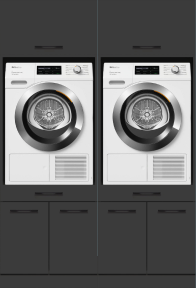
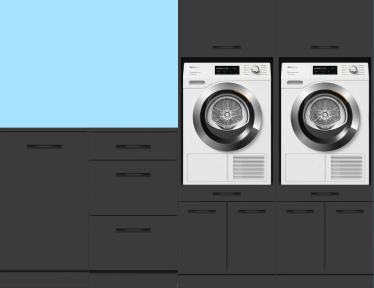
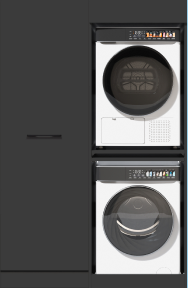
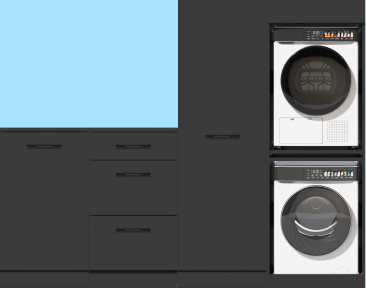
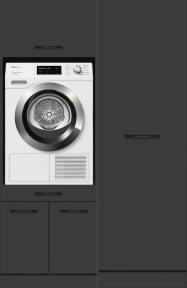
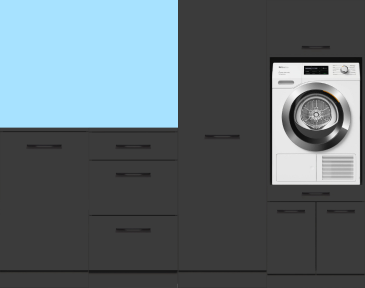
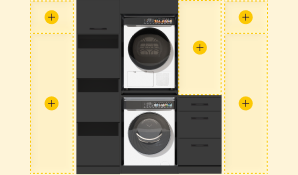
A washing machine cabinet can better distribute forces, fix the appliance, and reduce residual vibrations. Wasdroom cabinets are made of strong chipboard with melamine, have adjustable anti-vibration feet, and a special anti-tip lock. They are TÜV-certified and tested up to 240 kg (Double) or 120 kg (Single and Stack) load capacity. Models like the Wasdroom Enkel 1.0 or Dubbel 3.0 also offer ergonomics and neat storage space. Placing your washing machine and dryer on top of each other? Then read about washing machine and dryer stacked in a cabinet. Important: a cabinet does not replace structural reinforcement. Use a cabinet as a supplement after the floor has been sufficiently stiffened. Available for customers in the Netherlands and Belgium. See also: preventing vibrations and noise in a washing machine cabinet.
Water, drip tray, and floor-wall connection
Make the floor around the installation water-resistant: finish joints with a fillet tape and suitable sealing paste or PE foil under the finish floor. Place a drip tray with drainage and check hoses and faucet fittings. Avoid soft, spongy materials under the machine—stable, water-resistant floor finishing is essential.
Practical placement tips to prevent walking
- Make sure the machine is perfectly level and lock the adjustable feet.
- Check that transport bolts have been removed.
- Load the machine balanced and respect the maximum load.
- Place close to a load-bearing wall and near beam supports.
- Use vibration dampers only on a stiff floor.
- Keep the floor clean and dry for maximum grip.
Frequently Asked Questions
How can I reinforce the floor for my washing machine?
Start with a stiffer panel floor: lay 2 layers of 18 mm underlayment or plywood crosswise, glued and screwed, with staggered joints. Widen the bearing surface under joints where needed. For large spans or wide beam spacing, add extra beams or connect beams into a torsion box with cross ribs. Only then apply dampers. Extra mass (lewis plates or concrete tiles) can help, but only if the load-bearing capacity is sufficient.
What is the best floor for under a washing machine?
The best base is a stiff, continuous floor with sufficient load-bearing capacity. In concrete homes, a solid concrete floor is ideal. In attics or timber construction, a doubled panel floor on beams works excellently, optionally supplemented with lewis plates or local mass. More important than the material is the combination of stiffness, flatness, water resistance, and correct machine placement. A soft top layer without a stiff subfloor is not recommended. Read more about the best floor under a washing machine cabinet.
How do you prevent the washing machine from walking?
First reinforce the floor and choose a stiff, flat installation spot close to a load-bearing wall. Level and lock the feet. Remove transport bolts, load balanced, and respect the maximum load. On a stiff base, you can use vibration dampers or anti-slip cups for extra grip. Keep hose lengths short and ensure the machine cannot knock against anything.
Can I place a washing machine on a smooth floor?
Yes, provided the floor is stiff and flat and the feet are properly adjusted. Clean the surface for better grip. Use anti-slip cups or dampers where needed—but only on a solid base. Avoid wax or polish layers that reduce friction. On smooth, weak floors, the machine will walk more easily and noise will increase.

