


A washing machine on a riser that transmits vibrations is not only noisy but also bad for your floor and the lifespan of your appliance. With the right diagnosis and a few targeted adjustments, you can make your setup stable and safe again. Below you’ll find the quickest checks, practical fixes, and a professional solution that truly tames vibrations.
Quickly find the cause
- Check level – Is the machine perfectly level on all corners? Adjust the washing machine’s feet (not the riser’s) precisely. Practical steps can be found in Making your washing machine stable and level.
- Remove transport bolts – Were the transport bolts removed during installation? If not, the machine will vibrate excessively and “walk.” See tips in Preventing your washing machine from ‘walking’.
- Check the floor – Concrete and tiles are stable; wooden floors flex and amplify vibrations.
- Assess the riser – Thin or twisting frames act like springs. A riser should feel as rigid as a concrete floor. Read more in Washing machine riser: when and why to choose?.
- Prevent imbalance – Distribute laundry evenly, avoid spinning half-empty drums with heavy items, and check for worn shock absorbers.
- Use damping smartly – Anti-vibration mats and pads help mainly on hard floors; on springy floors, they can actually increase the effect. Unsure about a mat? Read: Anti-vibration mat for washing machine in a cabinet: necessary or not?
Want to quickly identify causes of excessive vibrations in a built-in setup? Read Why does my washing machine vibrate in the cabinet?.
Stabilize the riser to reduce vibrations
If your washing machine on the riser continues to cause vibrations, make the structure stiffer and connect it to fixed points where possible. Ensure a flat, continuous support plate under all feet and avoid “point loads” on thin strips. Unsure about the construction or the choice of riser? Read Is a washing machine riser worthwhile?. Add a cross brace to open frames to prevent twisting and reinforce corners with an L-profile. On smooth tiled floors, a thin layer of silicone sealant under the riser’s adjustable feet can act as anti-slip. If the setup is in a niche, anchor the whole unit with sturdy wall anchors into solid wall sections. After each adjustment, test with an empty short spin cycle and readjust the feet until the drum spins smoothly without lateral movement.
Professional, safe solution: a vibration-absorbing washing machine cabinet
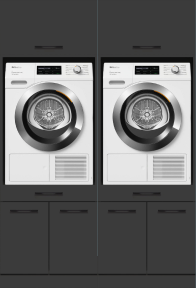
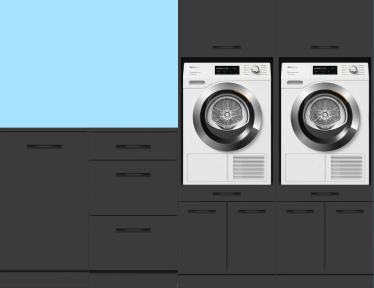
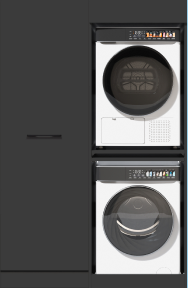
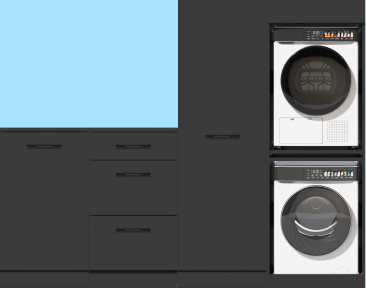
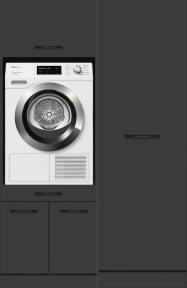
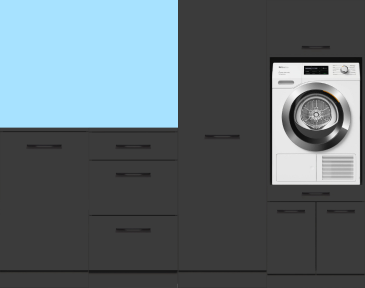
If you want a structural fix, choose a washing machine cabinet that absorbs vibrations and optimizes your laundry space. Wasdroom cabinets are made of strong chipboard with a melamine coating, combining flexibility and vibration absorption. They are moisture resistant, support up to 240 kg (Double) or 120 kg (Single and Stack), and feature a special anti-tip lock that prevents your machine from vibrating out of the cabinet.
- Safe and stable – Tilt lock and sturdy bracing around your appliance.
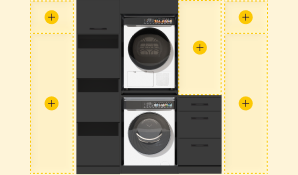
- Suitable setup – Choice of Single, Double, and Stack series for solo or washer-dryer combinations.
- Assurances – 10-year warranty, 30-day return period, and delivery within 2-4 weeks with choice of delivery day.
- Personal advice – Showroom, demo days, and an in-house technical service, also on location.
Curious what fits your floor and appliance? Request advice or configure your setup via the configurator at wasdroom.com.
Frequently Asked Questions
Why does my washing machine vibrate on the riser?
Usually due to a combination of a springy floor, a too flexible or twisting frame, and incorrect adjustment of the machine’s feet. Also, imbalance in the drum or transport bolts still in place cause strong vibrations.
What really helps against washing machine vibrations?
Start by leveling the machine and removing transport bolts. Then stabilize the riser with cross braces and wall anchors. On hard floors, anti-vibration mats can help. For a structural solution, a vibration-absorbing washing machine cabinet works best.
Is it bad if a washing machine vibrates?
Yes. Excessive vibrations accelerate wear of bearings and shock absorbers, increase the risk of damage and leaks, and can damage floors or walls. So address the cause immediately and improve the stability of your setup.

